
Arnold Name Meaning: History, Power, and Germanic Roots
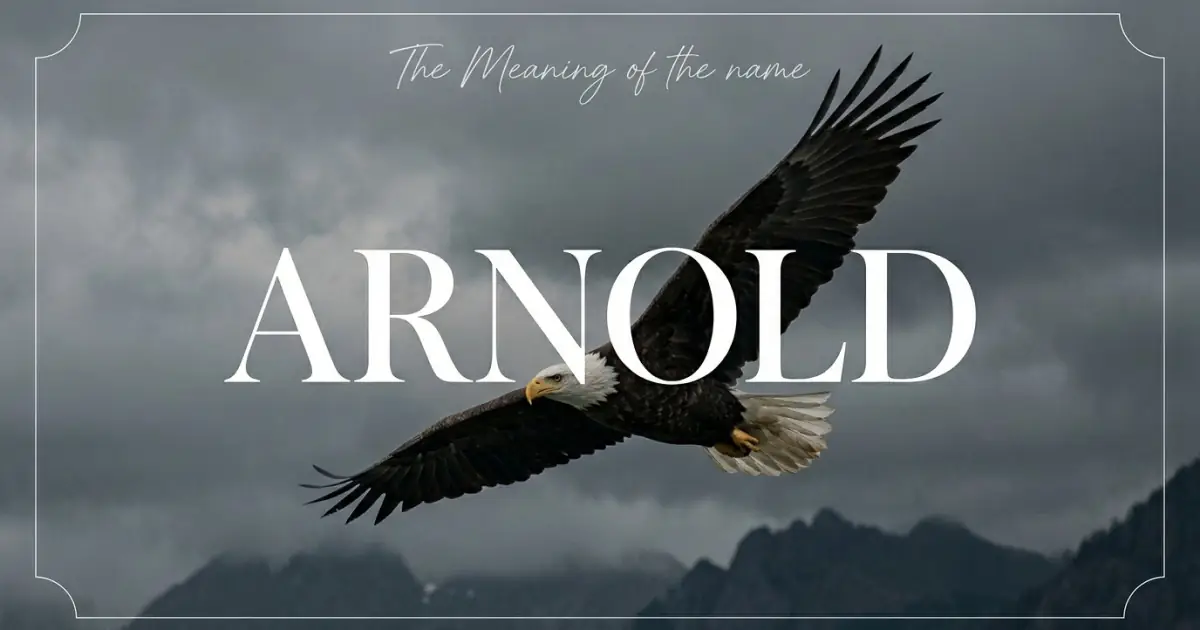
Arnold is a name with wings built into its meaning. “Eagle power” is not a soft image or a decorative phrase; it is a name-story about height, command, and force seen from above. The eagle suggests vision and altitude. Power suggests strength, authority, and the ability to act. Together, they give Arnold a meaning that feels old, elemental, and unusually direct.
That meaning matters because Arnold’s sound can sometimes be misread through modern style alone. To some ears, it may feel sturdy, vintage, even slightly reserved. But underneath that familiar surface is a Germanic name with a fierce symbolic center. Pronounced AR-nuld, Arnold has two syllables, a firm opening, and a grounded ending. Official 2024 data places Arnold at No. 1681 for boys in the United States, making it uncommon today but still present — a name with deep roots, a strong image, and room for revival.
Arnold's U.S. popularity rank over time, 1880–2024
Popularity statistics are based on official data from the Social Security Administration baby name records.
Arnold: A Dignified and Sturdy Vintage Pillar
Arnold presents a chart pattern of a broader past and a clearer present, reflecting a massive naming cycle that reached its highest momentum in the early 20th century. While its adoption is more selective today, its current standing suggests a “vintage revival” as parents rediscover heritage gems that feel both warm and authoritative.
The absence of crossover usage reinforced a focused masculine profile. Meaning “eagle power,” its simple two-syllable rhythm provides a sense of permanent resonance that has stood the test of time across naming style families.
Arnold carries the old force of eagle power into a modern name choice
| Key Facts | Information | Quick Insight |
|---|---|---|
| Name | Arnold | The name has a traditional shape, but its meaning gives it a sharper and more heroic inner image. |
| Primary Gender Usage | Male | Arnold has a clearly masculine profile, supported by its historic weight and current boys’ ranking. |
| Primary Origin | Germanic | The Germanic origin places Arnold in a naming world where strength, leadership, and symbolic animals often shaped identity. |
| Primary Meaning | Eagle power | The meaning combines vision and force, giving Arnold a name-story of strength guided by height and perspective. |
| Pronunciation | AR-nuld | The pronunciation is familiar and direct, with the main weight placed at the beginning. |
| IPA | US: /ˈɑːrnəld/; UK: /ˈɔːnəld/ | The accent difference mainly affects the first vowel and final “r,” while the two-syllable structure remains steady. |
| Syllable Count | 2 | Two syllables make Arnold substantial without making it difficult to use. |
| U.S. boys’ rank (2024) | No. 1681 | Arnold is rare in current use, but not absent; it has the profile of a vintage name waiting for the right family. |
The meaning of Arnold is not just strength, but strength with altitude
Arnold’s meaning, “eagle power,” has two parts that work together. Power alone can sound blunt. Eagle imagery changes that. It lifts the meaning upward and gives it a sense of vision, distance, and command. The eagle does not only strike; it surveys. It represents height before action, perspective before force.
The eagle gives Arnold its sense of vision
The eagle image gives Arnold a quality that feels larger than ordinary toughness. In symbolic language, eagles often suggest high sight, independence, and command of the air. For a name, that creates a powerful emotional field. Arnold is not merely a name of muscle. It is a name of lookout, leadership, and awareness.
This matters for parents who want strength in a name but not a crude or aggressive version of it. Arnold’s strength has a watching quality. It implies someone who can rise above immediate noise and see a wider field. That makes the meaning feel mature rather than simply forceful.
Power gives Arnold its grounded force
The second half of the meaning brings the name back to earth. Power suggests the ability to act, endure, protect, and command. It gives Arnold substance. Without the eagle image, power might feel heavy. Without power, the eagle image might feel distant. Together, they create balance: height with force, sight with action.
That balance gives Arnold a strong character meaning. It can suggest leadership, resilience, and steadiness. It does not feel fragile or decorative. It feels like a name that can stand inside a family line, a professional setting, or a literary character without needing to be softened.
Arnold’s Germanic origin explains why the name feels built rather than ornamental
Arnold belongs to the Germanic naming tradition, a world where names often carried compound meanings connected to strength, animals, battle, rule, protection, and honor. Names in this style were not usually chosen only for pleasant sound. They often carried a compressed statement of value. Arnold’s “eagle power” meaning fits that world naturally.

Germanic names often feel architectural
Some names feel floral, lyrical, or decorative. Arnold feels architectural. It is built from firm sounds and a compact meaning. The name does not glide so much as stand. That structure is part of its appeal, especially for families drawn to names that feel established and durable.
This does not mean Arnold lacks warmth. Rather, its warmth comes from dependability. It has the feeling of a name that has weathered time, moved through generations, and remained recognizable. Even when uncommon, Arnold does not feel invented or uncertain. It feels inherited from an older naming vocabulary of strength.
The meaning makes Arnold more vivid than its vintage surface suggests
Modern listeners may first hear Arnold as a traditional or old-fashioned name. That impression is understandable because Arnold has a familiar, sturdy shape. But the meaning gives it a more dramatic interior. “Eagle power” is vivid, almost heraldic. It belongs to banners, high places, and images of command.
This contrast is one of Arnold’s most interesting features. On the outside, it may seem sensible and grounded. Inside, it carries a winged symbol of force. That makes the name more layered than many people expect.
The sound of Arnold gives the name weight from the first syllable
Arnold is pronounced AR-nuld, with two syllables and first-syllable emphasis. The name begins with a broad vowel and an “r” sound in American pronunciation, then moves into a softer second syllable. That shape gives Arnold a strong beginning and a practical ending.
The opening syllable makes Arnold feel firm
The first syllable carries the main stress. In the U.S. IPA form, /ˈɑːrnəld/, the opening has a broad “ar” sound. In the UK form, /ˈɔːnəld/, the first vowel shifts in accent color, and the “r” may be less pronounced. In both cases, the first syllable remains the anchor.
This is part of why Arnold feels substantial. It does not begin lightly. The name announces itself with weight, then settles. The pronunciation supports the meaning: the name rises from a strong base rather than drifting into softness.
The ending keeps Arnold approachable
The second syllable, “nuld,” is softer and less stressed. It closes the name with a practical, grounded sound. The final consonant gives Arnold a firm landing, but the unstressed syllable keeps it from feeling too severe.
This sound pattern helps Arnold work across ages. It can feel sturdy on a child, serious on an adult, and dignified in later life. The name has a full shape, but it is not long or difficult.
Official data shows Arnold is rare today, but still alive in use
Official 2024 U.S. data places Arnold at No. 1681 for boys. That ranking tells an important story. Arnold is not currently a mainstream favorite, but it remains in use. It has not disappeared; it has simply moved into a quieter part of the naming landscape.
Arnold’s rarity gives it vintage distinction
Many parents today are drawn to names that feel familiar but not overused. Arnold fits that category. It is recognizable enough that most people can spell and say it, yet uncommon enough that a child named Arnold is unlikely to be one of several in the same class.
This is a useful balance. Some rare names feel hard to explain. Arnold does not. It is known, traditional, and easy to process. Its rarity comes not from difficulty, but from being outside the current top style cycle.
The ranking leaves room for a thoughtful revival
Names often move in cycles. A name that once felt too associated with earlier generations can later begin to feel distinctive, sturdy, or charming again. Arnold has that possibility. Its sound is strong, its meaning is vivid, and its usage is low enough to feel fresh to parents looking beyond the most common vintage revivals.
The name may appeal especially to families who like old-rooted boys’ names but want something less expected than Henry, Arthur, Theodore, or Frederick. Arnold shares some of that established feeling, but with a more forceful symbolic meaning.
Arnold belongs beside sturdy names with serious roots
Style-wise, Arnold sits near names such as Arthur, Walter, Alfred, Frederick, Bernard, Conrad, Edmund, and Roland. These names share a sense of age, structure, and seriousness. They are not sleek in a modern minimalist way. Their appeal comes from depth, history, and a certain old-world dignity. To discover what else belongs to this origin group, browse baby names in this origin group.
Arnold is stronger-edged than many gentle vintage names
Compared with Arthur, Arnold feels less literary and more forceful. Compared with Walter, it has a sharper symbolic image. Compared with Alfred, it feels more rugged. The “eagle power” meaning intensifies the name and gives it a commanding center.
This makes Arnold a good candidate for parents who like vintage names but want one with more muscle. It is not soft nostalgia. It is heritage with a strong spine.
Arnold feels traditional without feeling overly polished
Some classic names feel formal, smooth, or aristocratic. Arnold feels more grounded. It has practical strength rather than delicate refinement. That can be a major advantage for families who want a name that sounds capable, durable, and unpretentious.
In that sense, Arnold is not trying to be fashionable. It has a workmanlike dignity. It feels like a name that can carry responsibility, which suits its meaning well.
Arnold’s cultural impression is shaped by strength, age, and recognizability
Every name carries social impressions beyond its literal meaning. Arnold may feel vintage, sturdy, masculine, and slightly unexpected in a modern birth announcement. It is not a name that blends into the current wave of soft surnames, vowel-heavy choices, or newly invented boys’ names. That difference can be part of its appeal. If you want a wider view beyond Arnold, browse familiar and rare boy names.
Arnold sounds grown-up from the beginning
Some names feel charming on a baby but need time to grow into adulthood. Arnold works in the opposite direction. It already sounds adult, established, and complete. For some parents, that maturity may be exactly the point.
A baby can grow into Arnold rather than outgrow it. Childhood nicknames can soften it when needed, but the full name has long-term strength. That gives it practical value as well as symbolic weight.
The name’s seriousness can be softened by pairing and nickname
Arnold’s strength is real, but so is its seriousness. A gentle middle name, warm family nickname, or softer surname can bring balance. Arnold James feels classic. Arnold Leo feels lighter. Arnie brings warmth. Ari gives a more modern and compact nickname route.
This flexibility matters because the name itself is substantial. Parents can choose whether to emphasize its old-world power or soften it for daily life. The full name remains strong either way.
Three next paths from Arnold
Once the meaning of Arnold is clear, the practical naming questions become more focused. Because Arnold is strong, vintage, and two syllables, the middle name, nickname, and pronunciation all shape how it feels in everyday use.
Middle names can brighten or deepen Arnold
Arnold pairs well with both classic and lighter middle names. Arnold James, Arnold Thomas, and Arnold Edward deepen its traditional side. Arnold Leo, Arnold Jude, and Arnold Miles make it feel more approachable. The best middle-name choice should consider surname length, initials, and whether the family wants Arnold to feel formal, warm, or quietly revived. If you want the full pairing logic behind that contrast, see middle names for Arnold.
Nicknames can bring Arnold closer to daily life
Arnold has several plausible nickname routes. Arnie feels friendly and vintage. Ari feels shorter and more modern. Arn is clipped and sturdy. A nickname guide can help parents decide whether they want a warm childhood form, a mature short form, or simply the full Arnold. To see how those different moods shorten in real life, explore Arnold nicknames.
Pronunciation keeps Arnold steady across accents
Arnold is pronounced AR-nuld. The U.S. IPA form is /ˈɑːrnəld/, while the UK form is /ˈɔːnəld/. The main accent difference appears in the first vowel and the treatment of “r,” but the name remains two syllables with first-syllable stress. If you want the full sound pattern behind that rhythm, read Arnold pronunciation guide.
Why Arnold still has the force of an eagle in flight
Arnold is not a fragile name, and it is not a fashionable whisper. It is an old-rooted name with a high, fierce image at its center. “Eagle power” gives Arnold more than strength; it gives strength a vantage point. The name suggests force that can see, command that can rise, and courage that carries perspective.
That is why Arnold deserves more than a quick vintage label. It is recognizable, rare in current use, and rich with symbolic force. Its Germanic origin gives it structure. Its sound gives it weight. Its meaning gives it wings. For parents looking for a name that feels sturdy, storied, and quietly ready for revival, Arnold stands like a figure on a high ridge: grounded below, watchful above, and powerful enough to lift its old meaning into a new life.