
How to Pronounce Ariana: Where People Often Hesitate and Why

Ariana is the kind of name that often gets tested in one very ordinary moment: a teacher reaches it on the attendance sheet, pauses just long enough to decide where the stress belongs, and then either says it with confidence or breaks its music by placing the weight in the wrong place. The same thing happens at graduation, in waiting rooms, at coffee counters, and in first introductions. Ariana is not difficult in the way some highly unfamiliar names are difficult. Its challenge is subtler. It asks the speaker to hear its shape, not just its letters.
That shape matters because Ariana is a name of scale. Official data shows it remains visible in current American use, and part of its staying power is that it sounds expansive without becoming heavy. The pronunciation given here is ar-ee-AH-nuh, with IPA shown as /ˌɑːriˈɑːnə/ in both US and UK English. That tells you something immediately important: the center of the name carries the true force. Ariana opens gently, gathers itself, then blooms in the third syllable. Once that pattern is heard, the whole name becomes much easier to say naturally.
What the sound pattern of Ariana is really clarifying
Ariana works best when the speaker hears it as a four-syllable line with a clear emotional center. The first two syllables prepare the name. The third syllable carries the stress. The last syllable softens the landing.
| Element | Phonetic Detail | Quick Tip |
|---|---|---|
| Everyday pronunciation | ar-ee-AH-nuh | Let the third syllable carry the main emphasis. That is where the name opens fully. |
| IPA (US) | /ˌɑːriˈɑːnə/ | The stress mark before the third syllable shows where the name’s real weight belongs. |
| IPA (UK) | /ˌɑːriˈɑːnə/ | The same phonetic target appears here, which means the core pronunciation stays stable across major English accents. |
| Syllable count | 4 syllables | Do not rush the name into three beats. Ariana needs room to unfold. |
| Stress pattern | Primary stress on AH | The first two syllables are lighter. The third syllable is the point of arrival. |
| Ending sound | -nuh | Finish softly rather than hitting the last syllable too hard. |
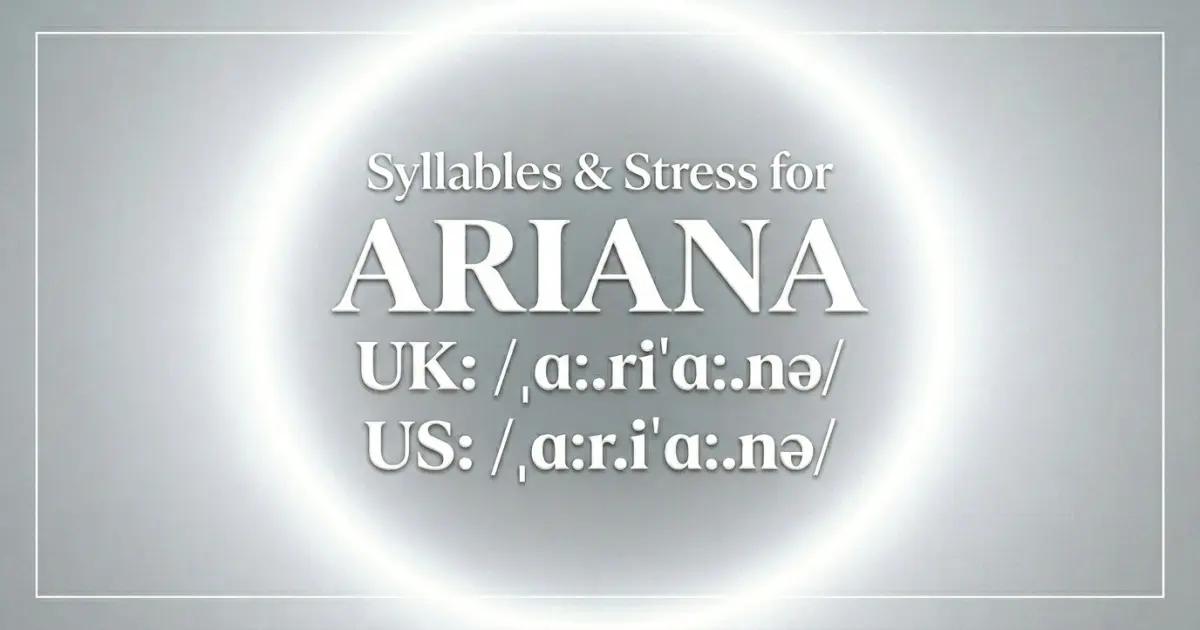
Ariana rises in the middle, and that is why Ariana sounds expansive
The most important thing about Ariana is not simply that it has four syllables. It is that those four syllables are not equal. The name is built like an arch. The opening prepares the listener, the center carries the meaning, and the end releases the line. If the speaker flattens that arch, Ariana loses much of what makes it beautiful. Before focusing only on syllables and stress, it helps to step back into the fuller frame of Ariana meaning.
The opening of Ariana should stay light enough to move
The first two syllables, ar-ee, are not where the name wants to live emotionally. They are there to gather momentum. In phonetic terms, the name begins with an open vowel followed by an r, which is a liquid consonant. Liquid consonants help names feel flowing rather than abrupt, and that is part of why Ariana sounds smooth from the start. The second syllable, ee, keeps the line moving forward instead of letting the opening become heavy.
If a speaker places too much weight on the first syllable, the name can start to sound more rigid than it should. Ariana does not want to strike the ear like a block. It wants to unfold. The opening should therefore be clear, but not dominant.
The heart of Ariana is the broad AH in the third syllable
The stressed AH syllable is the true center of the name. In the IPA, this is where the primary stress lands, and in everyday listening it is the moment when Ariana becomes fully itself. That broad vowel gives the name resonance. Without it, Ariana would still be pretty. With it, the name acquires scale.
This broad center matters for more than pronunciation accuracy. It is what gives Ariana its ceremonial feel. The sound opens outward, which is one reason the name feels large enough to carry a meaning like “most holy.” The name needs space, and the stressed middle provides it.
The ending of Ariana should settle, not compete
The final -nuh closes the name gently. It is not supposed to rival the stressed center. It is there to release the line and make the full name usable in ordinary speech. This is a major reason Ariana remains wearable despite its length. The ending comes down softly after the name’s broad middle lift.
If the final syllable is overpronounced, the name can sound more theatrical than natural. If it is swallowed completely, the name can feel unfinished. The best pronunciation gives it a light, human finish.
Ariana sounds steady across English accents because the structure does not change
Some names shift substantially between American and British English. Ariana, as presented here, does not. The IPA is the same in both varieties, which means the name’s essential pattern remains stable. That stability is one of its practical strengths.
Ariana in American and British English keeps the same center of gravity
An American speaker may color the vowels slightly differently from a British speaker, and regional accents may make the liquid r more or less prominent depending on how rhotic the speech is. But those are accent textures. They do not change the name’s core identity. The primary stress still falls on AH, and the overall movement of the name remains the same.
This makes Ariana easier to carry across different English-speaking settings. The name may sound a little warmer or a little smoother depending on the speaker, but it will still be recognizably Ariana. That kind of stability builds confidence around a name.
Why Ariana feels more complex on paper than it is in speech
The spelling can look slightly longer and more elaborate than the spoken form feels. That is common with names that have several open vowels in sequence. But once the rhythm is heard aloud, Ariana is surprisingly straightforward. There are no unstable consonant clusters and no major stress debates in the form given here. The key is simply to hear the four-beat line and let the third syllable bloom.
Where Ariana most often gets bent out of shape
Because Ariana is familiar, speakers sometimes rush it. They assume they know it and then flatten or misplace the emphasis. The most common errors usually come from stress and pacing rather than from any real phonetic obstacle.
The most common mistake is stressing the wrong syllable
If the speaker leans too heavily on the opening, the name can lose its balance. Ariana should not feel front-loaded. The first two syllables are a lead-in. The third syllable is the arrival point. When that balance changes, the name becomes less graceful and more mechanical.
Another mistake is compressing Ariana into fewer beats
Some speakers rush long familiar names by clipping them into a faster pattern. With Ariana, that can make the line feel cramped. The name needs four syllables to breathe correctly. Compressing it too much removes the very spaciousness that gives it elegance.
Sound neighbors can also encourage rushed guessing
Ariana sits near names such as Arianna, Adriana, and Mariana in the English-speaking ear. Because these names all share vowel-rich patterns and similar endings, a speaker may slide toward a familiar neighbor if moving too quickly. That is why keeping the four-syllable frame clear matters so much. Ariana is easy once the internal rhythm is respected. When the stress sits in the center, the nickname logic often follows that same center of gravity, which is why nicknames for Ariana is the natural next step.
Ariana sounds best when practiced as a rising line
The easiest way to get Ariana right is to treat it as a name that rises toward its center rather than attacking it from the front. The opening is preparation. The third syllable is where the emotional light turns on.
Start with the frame: ar + ee + AH + nuh
Say the first syllable lightly. Add the second without slowing down too much. Then open the third syllable fully: AH. Finish with a soft nuh. Put together, the line should feel like one steady expansion rather than four disconnected blocks.
When said naturally, ar-ee-AH-nuh should sound spacious but not overcareful. The rhythm is what matters most.
Use real sentences instead of isolating the name
Names settle better inside everyday speech. Try these aloud:
Ariana is here.
I saved this for Ariana.
Ariana will join us later.
These lines help preserve the stress and stop the name from sounding too staged. The middle should still carry the weight, but the whole name should move easily.
Listen for breadth, not heaviness
The best pronunciation of Ariana sounds open and elevated, but not dramatic for drama’s sake. It should feel lifted, spacious, and natural. Light opening, full middle, soft ending. That is the shape that makes the name memorable and lets its meaning sound plausible rather than overstated.
Common Questions About Saying Ariana
How do you pronounce Ariana in everyday English?
Ariana is usually pronounced ar-ee-AH-nuh, with the main stress on the third syllable.
What is the IPA for Ariana?
The IPA shown here is /ˌɑːriˈɑːnə/ in both US and UK English.
What part of Ariana carries the stress?
The main stress falls on the AH syllable, which is the emotional and phonetic center of the name.
What is the most common pronunciation mistake with Ariana?
The most common issue is placing too much emphasis on the opening or rushing the name so that the four-syllable rhythm collapses.
Is Ariana difficult for English speakers to say?
Not usually. It is a longer name, but the pronunciation becomes straightforward once the speaker hears that the stress belongs in the middle rather than at the front.