
Aria Name Meaning: A Refined Name with Strong Roots
Aria is one of the rare modern names that sounds as if it is made of almost nothing and yet has become one of the most durable choices in current use. It begins with air. It begins with song. It begins, in other words, with things that cannot be held in the hand but can still take over a room. That is the tension that gives the name its force. Aria feels weightless in the mouth, but it has turned out to be socially solid. A name that might once have seemed too lyrical, too aesthetic, or too fragile for ordinary life has instead become one of the clearest examples of how beauty can harden into structure without losing grace.
That is why Aria matters beyond its surface prettiness. It is not only a musical or atmospheric word promoted into a first name. It is a name that proves how modern parents now think about identity. They are often drawn to names that sound open, fluid, and artful, but they still want those names to work on school lists, official forms, and adult introductions. Aria has passed that test. Official Social Security Administration (SSA) data places it at No. 26 for girls in 2024, with only minimal use for boys at No. 4703. That level of acceptance means Aria is no longer merely stylish. It is settled. It has become a name that sounds light but behaves like a classic.
Aria's U.S. popularity rank over time, 1900–2024
Popularity statistics are based on official data from the Social Security Administration baby name records.
Aria: A Melodic Standout with Cross-Lane Visibility
Aria behaves like a name with one home base plus a smaller second track, where the girls’ side carries its primary momentum. Its widespread appeal likely stems from its melodic Italian roots and its fit with a style family of names that parents trust for being both “fresh and familiar” .
While the boys’ side shows secondary visibility, the name remains a definitive feminine melodic choice. Meaning “air” or “melody,” its soft three-syllable sound travels exceptionally well in the modern landscape.
Aria in one clear frame
Before the deeper history and style analysis, it helps to see Aria as it stands now: a feminine name with Italian roots, a musical meaning, a simple pronunciation, and a public presence strong enough to make it feel established in contemporary life. To view more names linked to this cultural tradition, explore more names from this origin.
| Key Facts | Information | Quick Insight |
|---|---|---|
| Name | Aria | The name is visually light and instantly modern, but it carries enough clarity to feel more anchored than many trend-driven choices. |
| Primary Usage | Female | Aria reads overwhelmingly feminine in current U.S. use, though its stripped-down structure gives it more versatility than highly ornamental names. |
| Origin | Italian | The Italian origin helps explain the name’s musical elegance and why it arrived already sounding polished. |
| Meaning | Air; melody | Few names fuse atmosphere and music so directly; Aria feels both spacious and composed at the same time. |
| Pronunciation | AR-ee-uh | The syllables are easy to hear and repeat, which is part of why the name wears so well in daily speech. |
| IPA | US: /ˈɑːriə/ · UK: /ˈɑːriə/ | The same U.S. and U.K. form means the name keeps its shape cleanly across major English-speaking accents. |
| Syllable Count | 3 | Three syllables give Aria lift and movement without making it feel long or formal. |
| U.S. girls’ rank (2024) | No. 26 | Aria is firmly mainstream now, which means it has moved beyond novelty into lasting public recognition. |
| U.S. boys’ rank (2024) | No. 4703 | There is a trace of cross-gender use, but the social identity of the name remains clearly female. |

Aria turns breath and music into identity
The first thing Aria offers is sound before meaning. That matters. Many names require explanation before their appeal becomes clear. Aria does not. You hear it once and it already seems to move. The opening vowel gives it space. The liquid r in the middle lets the voice continue rather than stop. The final open syllable prevents the name from sounding clipped or abrupt. Even before anyone knows the definition, the name behaves like air and melody. It is one of those rare cases where phonetics and meaning feel aligned.
That alignment is a major reason for the name’s popularity. A name meaning “air; melody” could easily feel too conceptual, too obviously artistic, or too impractical for ordinary life. Aria avoids that because the word is compact and the sound is stable. It suggests atmosphere, but it does not drift. It suggests music, but it does not sound theatrical. Its great accomplishment is that it takes two intangible things and turns them into something socially workable.
Research on naming taste has long shown that parents are drawn not only to meanings, but to impressions: what a name feels like to say, how quickly it can be imagined on a child, and whether it seems capable of growing. Aria performs unusually well on those tests. It is lyrical, but not fragile. It is feminine, but not overloaded with decoration. It is modern, but not synthetically modern. In that sense, Aria belongs to a family of names that feel inevitable after the fact. Once they are in circulation, it becomes hard to imagine why they were not always there.
The name also reflects a broader shift in contemporary naming: a growing willingness to treat words associated with art, atmosphere, or sensory beauty as legitimate first names rather than poetic side-notes. What changed was not the existence of such words, but the confidence to place them directly in everyday use. Aria arrived at exactly the right moment for that shift. It sounds beautiful enough to attract attention, but simple enough to keep attention from turning into strain.
How Aria moved from music term to given name
From the world of song into ordinary life
Historically, the word aria belongs to the language of music. It refers to a song or melodic piece, most famously associated with the solo moments of opera. Naming references have long treated it in that musical sense, describing Aria as “song,” “melody,” or “solo opera piece.” That background matters because it explains the name’s immediate prestige. Aria did not emerge as a random sound sequence. It came preloaded with artistry.
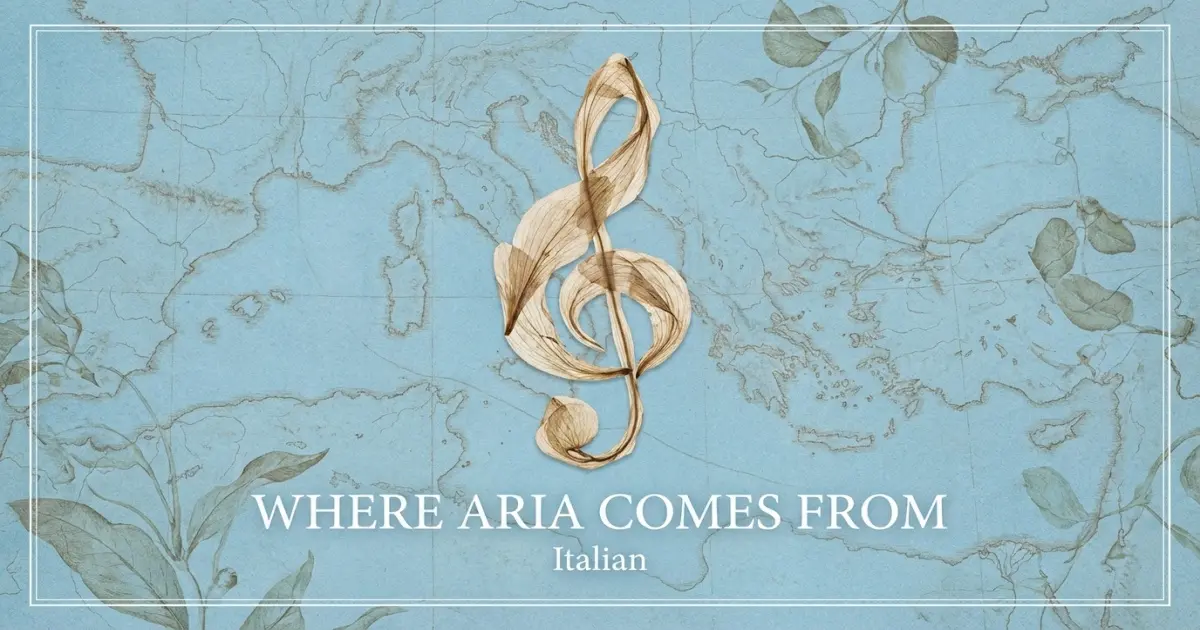
And yet that origin alone would not have guaranteed success as a first name. Plenty of beautiful art words never make the leap into ordinary naming. Aria did because the sound was already suited to personal use. It has only three syllables, clear stress, and no awkward consonant clusters. It looks elegant on the page and stays easy in speech. In naming terms, that is an unusually fortunate combination.
Why Aria feels contemporary rather than antique
Even with its artistic background, Aria does not feel antique. It does not sound like a revival pulled from a museum of old forms. Instead, it fits squarely into the present. This is partly because the word is still alive in ordinary cultural vocabulary. People may not all know opera in detail, but many recognize the term, or at least sense its musical atmosphere. That gives the name cultural texture without requiring specialist knowledge.
It also helps that Aria belongs naturally to a broader naming climate that favors vowel-rich, open-ended girls’ names. Modern parents have often preferred names that feel bright, mobile, and visually clean, and Aria fits that taste precisely. But unlike some newer names created only for sound, Aria has inherited meaning and usage behind it. That history gives it more backbone than some of its stylistic neighbors.
This combination of artistic origin and contemporary shape explains why Aria can sound fashionable without feeling shallow. It is not merely a modern invention. It is a modern adoption of an older word whose sound happened to be ready for a new life.
Aria in the current naming landscape
A U.S. girls’ rank of No. 26 in 2024 places Aria among the most publicly established names of the moment. That rank says more than simple popularity. It shows that Aria has crossed a crucial threshold: it is now a name people expect to encounter, not just admire from a distance. It has become fully legible to teachers, relatives, receptionists, and peers. That legibility matters enormously in daily life.
At the same time, Aria retains enough contour to feel more selective than older staples. Its popularity has not erased its atmosphere. That is a difficult balance to keep. Some names rise so quickly that they become flattened by repetition. Aria has so far resisted that flattening because the sound is distinctive enough to retain identity even at scale.
The tiny male ranking is also revealing. It suggests that while Aria has a trace of broader usability, the public understanding of the name remains overwhelmingly female. That stability can reassure parents who like softness and fluidity but do not want ambiguity to dominate the name’s social reading. You can also compare Aria with other choices in more feminine name ideas.
Most importantly, the rank confirms that Aria is no longer merely an “interesting” choice. It is a functioning part of the mainstream naming system. That means the name has survived the most important modern test: not whether it can attract admiration once, but whether thousands of families can imagine living with it year after year.
Aria among its closest sound-neighbors
Why Aria is not just another airy girls’ name
Aria lives near names like Ava, Isla, Ella, Mia, and Aurora in the broader contemporary naming landscape, but it does not sound interchangeable with any of them. Ava is shorter and more grounded. Isla is breezier and more visually specific. Ella is softer and more domestic. Mia is tighter and more informal. Aurora is grander and more difficult in the mouth. Aria occupies a distinct middle ground: lyrical without being elaborate, elegant without being distant, musical without being over-staged.
This positioning is one reason the name works so well. It gives parents access to the same contemporary lightness they may hear in other fashionable names, but with a more cultivated internal logic. Aria is not just phonetically pleasing. It carries a meaning people can feel inside the sound.
What the sound of Aria is doing socially
Phonetically, Aria is made of openness. It begins with a broad vowel, glides through a liquid consonant, and ends on unstressed openness again. There is no hard stop anywhere in the name. That gives it a sense of flow, which matches its musical meaning but also affects how people perceive it socially. Names with this kind of structure often feel expressive, graceful, and emotionally quick.
But Aria is not flimsy. The stress lands clearly at the front, which gives the name form. That stress is important. Without it, the name would risk sounding vaporous. With it, Aria feels poised rather than floaty. It has just enough internal architecture to keep its airiness from dissolving into vagueness.
Where Aria naturally opens into the next choices
Once parents decide on Aria, the next questions usually arise quickly. What kind of middle name keeps the full combination from sounding too soft? Will a short nickname emerge, or is Aria itself already compact enough to stay whole? And since the pronunciation looks intuitive but not trivial, what should families know about how it is actually said in everyday English? These are not side issues. They are part of how the name functions beyond first impression.
Middle names that give Aria more shape
Because Aria already carries motion and atmosphere, it often pairs best with middle names that add firmness, lineage, or a cooler edge. The full name usually benefits when the second element brings some structure to contrast the first name’s openness. If you want the full pairing logic behind that contrast, see Aria middle names.
Nicknames that may or may not be necessary
Aria is already relatively short, which means many families may never feel pressure to nickname it heavily. Still, its sound does allow for affectionate trimming, and those choices often reveal how intimate or streamlined a family wants the name to feel in daily life. To see how those different moods shorten in real life, explore nicknames for Aria.
Pronunciation that looks simpler than people expect
Although Aria is easy to say once heard, some readers can still pause over the vowel sequence on first sight. That makes pronunciation guidance useful, especially for families who want a name that stays elegant without becoming fussy in introductions. If you want the full sound pattern behind that rhythm, read how to pronounce Aria.
Why Aria keeps its balance
The deepest success of Aria is balance. It carries artistic meaning without sounding precious. It sounds modern without being flimsy. It has become popular without becoming faceless. That is not a small achievement. Many names can manage two of those things for a while. Far fewer manage all three at once.
Part of the reason is that Aria is fundamentally well-built. The sound matches the sense. The spelling is attractive without being impossible. The rhythm is musical without becoming overwrought. And the name is short enough that people can live inside it without feeling they are constantly performing it. That livability is what transforms an appealing word into a successful name.
It also helps that Aria belongs to one of the strongest currents in contemporary naming: the move toward names that feel light, sensory, and emotionally immediate. But unlike some names that ride that wave, Aria still has its own conceptual center. “Air; melody” is not vague. It is vivid. The name comes with an image and a sound-world already attached. That gives it more staying power than many purely decorative choices.
So the lasting meaning of Aria is not simply that it denotes air or music. It is that it shows how something intangible can still become socially solid. Aria makes atmosphere inhabitable. It takes breath and melody, two things that vanish the moment they are made, and turns them into a name people can carry for a lifetime. That is why Aria still feels alive even at the height of its popularity. It sounds like motion, but it holds.
What Aria promises by being Aria
In literary terms, Aria is a name about form holding something invisible. Music disappears as soon as it is heard. Air cannot be grasped at all. Yet both shape human life constantly. Aria captures that paradox more elegantly than most names ever could. It offers lightness, but not emptiness. It offers beauty, but not mere ornament. It offers movement, but not instability.
That is why the name has become more than a fashionable choice. Aria has turned into a durable answer to a distinctly modern naming wish: the wish for something graceful, contemporary, and emotionally alive, but still strong enough to stand in ordinary life. It gives parents a name that sounds like art and behaves like identity. And in that sense, the name’s meaning keeps widening. Aria is not only air. Aria is not only melody. Aria is proof that what seems most delicate can sometimes last the longest.