
How to Pronounce Antonio: Syllables, Stress, and Common Mistakes
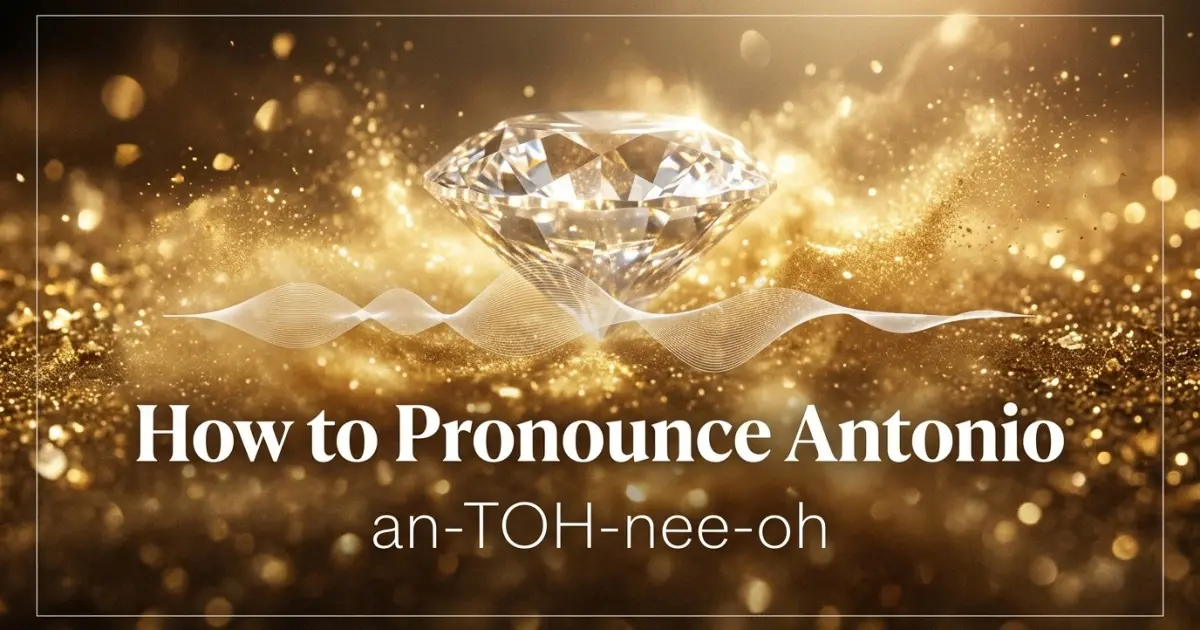
Antonio is one of those names many people learn by ear before they ever study the spelling. It turns up in roll calls, locker-room introductions, wedding readings, airport boarding lines, stage credits, and sports commentary, where the speaker has only a second to decide whether to say it casually or with a little extra care. That real-life pressure matters, because Antonio is not difficult in the way some names are difficult. Its challenge is subtler. People see four syllables, recognize a Spanish and Italian atmosphere around the name, and then hesitate: should the ending be clipped, stretched, or softened? Should the opening sound broad, bright, or neutral? The name asks for confidence more than effort.
Once heard correctly, though, Antonio settles quickly into place. In everyday English, the shape is clear: an-TOH-nee-oh. The stress falls in the center, on TOH, and that stressed syllable does almost all the structural work. The beginning is brief, the middle is firm, and the last two syllables flow out rather than stop hard. That is why Antonio feels more elegant than cumbersome. It has movement built into it. The best pronunciation does not over-explain the name. It lets the vowels do what they naturally want to do and allows the rhythm to carry the listener forward.
How Antonio is actually said when people know what they are doing
The fastest way to make Antonio sound natural is to understand where the stress sits, how the ending relaxes, and how the American and British forms stay close while not sounding mechanically identical.
| Element | Phonetic Detail | Quick Tip |
|---|---|---|
| Common pronunciation | an-TOH-nee-oh | Think of Antonio as four beats, but let the second beat carry the weight. |
| U.S. IPA | /ænˈtoʊnioʊ/ | In American English, the stressed vowel opens clearly into a strong “toh.” |
| U.K. IPA | /ænˈtəʊniəʊ/ | The British version stays close in structure but may sound slightly lighter through the vowels. |
| Syllable count | 4 syllables | Do not flatten the name into three beats or force every syllable equally. |
| Main stress | Second syllable: TOH | If the stress moves away from TOH, the whole name starts to sound unsteady. |
| Ending sound | -nee-oh | Keep the ending flowing; it should feel smooth, not chopped into separate pieces. |
| Nickname clue | Tony, Tonio | Hearing Tony often helps people locate the natural stress point inside Antonio. |
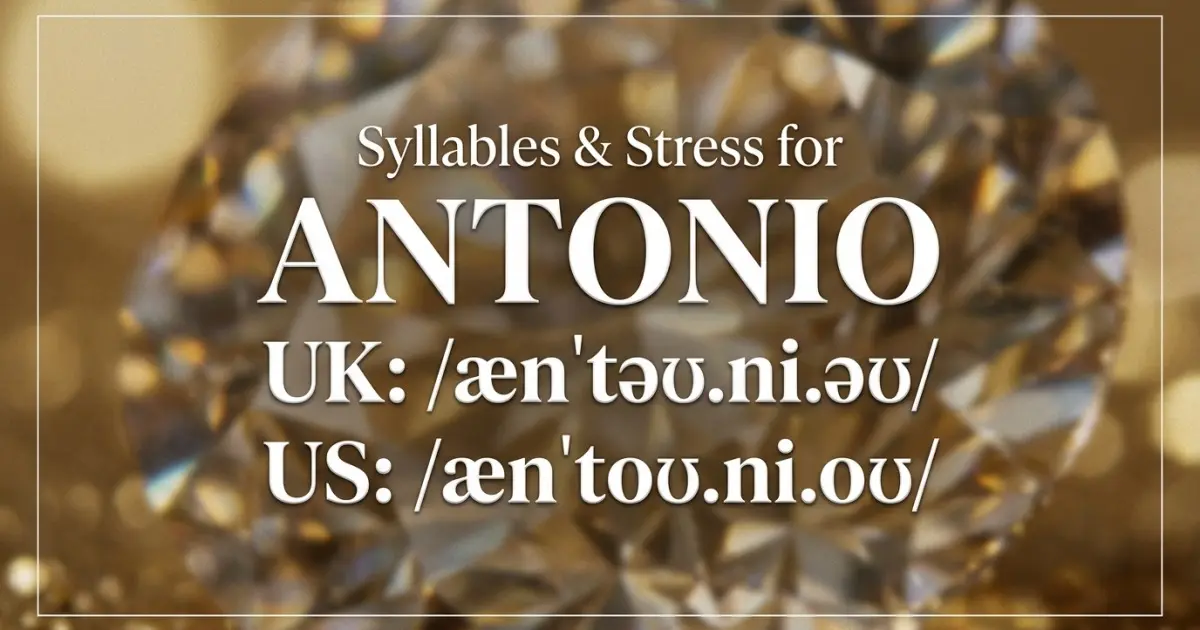
Antonio holds together because the stress sits in exactly the right place
Four syllables do not mean four equal weights
One of the easiest mistakes with Antonio is to pronounce it too mechanically, as if each syllable deserved identical force. That creates something stiff and over-separated: an-TOH-nee-oh becomes AN-TOH-NEE-OH, and the name loses the relaxed confidence that makes it attractive in the first place. In natural English speech, unstressed syllables shorten. They are lighter, quicker, and less fully held. That is not laziness. It is how fluent rhythm works. Pronunciation lands more fully when the name’s roots and history are already in view, so begin with Antonio meaning.
Antonio succeeds because the second syllable acts as the anchor. Once TOH is clearly stressed, the rest of the name organizes itself around it. The opening an becomes a short lead-in, and the final nee-oh becomes a graceful release. In that sense, Antonio behaves like many elegant multisyllabic names: one central syllable carries the posture, while the others shape the entrance and exit.
Why the ending should move, not stop
The final two syllables, nee-oh, are where speakers often become self-conscious. Some try to strike each syllable too separately, producing a slow, overcareful ending. Others rush through it and lose the final vowel altogether. The most natural pronunciation sits between those extremes. You want to hear both syllables, but you want them linked. Antonio should feel like one continuous line, not like a staircase.
The consonants help with this. The n is a smooth nasal consonant, and the name contains no harsh fricative or stop that interrupts the flow near the end. That is one reason Antonio sounds so melodic even in English. There is very little resistance in the second half of the name. Once the stressed vowel is placed correctly, the rest follows with surprising ease.
Where Antonio shifts across accents without losing its identity
American and British English stay close, but not identical
The American and British IPA forms remain structurally similar: /ænˈtoʊnioʊ/ in the U.S. and /ænˈtəʊniəʊ/ in the U.K. Both keep the same number of syllables, both stress the second syllable, and both preserve the open final movement of the name. That means Antonio travels well. Speakers on either side of the Atlantic may shade the vowels a little differently, but no one is dealing with a fundamentally different name.
In American speech, the stressed TOH often sounds fuller and rounder, giving the name a slightly broader center. In British speech, the same syllable can sound a touch lighter depending on accent, but the overall architecture remains intact. The child named Antonio is therefore unlikely to face deep confusion between U.S. and U.K. use. The changes are more about color than structure.
Spanish and heritage influence can deepen the vowels
Because Antonio is so strongly associated with Spanish and Italian usage, some families will naturally pronounce it with a more heritage-shaped rhythm and purer vowels. In those contexts, the name can sound more open and slightly more evenly paced than in default English. That is not a mistake. It is part of the name’s broader linguistic life. What matters is consistency within the family and community using it.
For English-language guidance, though, the safest everyday pattern remains the same: brief opening, strong middle stress, smooth final release. Antonio is flexible across accents because its stress pattern is stable even when the exact vowel quality shifts.
Where Antonio usually gets mispronounced and how to fix it fast
The stress sometimes slips forward or spreads too wide
The most common pronunciation error is stress drift. Some speakers flatten the name, giving every syllable too much attention. Others over-emphasize the opening and end up with something less balanced than Antonio wants. The fix is simple: locate TOH and let it do the work. Once that middle syllable is strong, the rest of the name becomes easier to carry.
The ending gets either chopped or swallowed
Another recurring issue is what happens at the end. Speakers who are nervous often chop the name into nee and oh too sharply, making it sound segmented. Speakers moving too quickly may nearly erase the final oh. Antonio sounds best when the ending is audible but connected. The two final syllables should feel like one flowing gesture rather than two separate announcements.
Sound neighbors can pull Antonio in the wrong direction
Antonio lives near several related names and nicknames: Anthony, Anton, Antoine, Tony, Tonio. These neighbors are useful reference points, but they can also distort pronunciation if speakers borrow the wrong stress pattern or ending shape. Anthony, for example, lands differently and does not train the ear for Antonio’s final vowels. Tony is more helpful because it preserves the stressed center. Tonio helps even more, because it reminds speakers that the latter half of the name should remain fluid and open. When the stress sits in the center, the nickname logic often follows that same center of gravity, which is why nicknames for Antonio is the natural next step.
That is often the best practical advice: if you can comfortably say Tony and Tonio, you are already close to saying Antonio well.
Antonio becomes easy once you practice it in real speech
Practice lines work better than isolated repetition
The most effective way to learn Antonio is not to repeat the name in a vacuum ten times with exaggerated care. It is to put the name inside ordinary sentences. Say, “Antonio is here,” “This is Antonio,” or “Antonio will call you back.” These lines make the name behave as it would in real speech, which is where natural stress and pacing show themselves best.
You can also pair Antonio with likely middle names or surnames. “Antonio James,” “Antonio Rafael,” or “Antonio Ruiz” immediately show whether the rhythm feels coherent. If the name sounds smooth in motion, the pronunciation has probably settled correctly.
Use the internal beat to keep the name steady
A useful memory trick is to hear Antonio as a name with a heartbeat in the center: an-TOH-nee-oh. Do not start heavy. Do not end abruptly. Just give the name its center and allow the rest to fall into place. Once speakers stop trying to prove how carefully they are pronouncing Antonio, they usually discover that the name has been helping them all along. Its vowels are open, its consonants are cooperative, and its structure is far more stable than its length first suggests.