
Amora Name Meaning: Meaning, Associations, and Timeless Style

Amora is one of those names that seems, at first glance, almost too transparent. It means “love.” The sound is warm. The shape is soft. The emotional charge is immediate. And yet that first impression is not the whole story. What makes Amora compelling is that it does not present love as decoration or sweetness alone. It gives the idea structure. The name comes into English-speaking ears with a strong middle stress, a Romance-language inheritance, and a meaning large enough to belong not only to romance but to loyalty, tenderness, attachment, and human warmth itself. In other words, Amora does not merely sound lovely. It asks what kind of love a life might make visible.
That is why the name lands differently from many other gentle modern favorites. Some names feel soft because they are airy. Amora feels soft because it is grounded in a word people already understand at a deep level. Historically, reference works place it in Spanish usage and connect it back to the Latin amor, which gives the name both intimacy and pedigree. The result is unusually effective. Amora feels contemporary without sounding invented, romantic without becoming flimsy, and emotionally direct without losing elegance. It takes one of the most universal human meanings and turns it into something a child can wear every day.
Amora's U.S. popularity rank over time, 1984–2024
Popularity statistics are based on official data from the Social Security Administration baby name records.
Amora: A Lyrical and Radiant Symbol of Love
Amora presents as a name with one unmistakable center of gravity, where the girls’ side of the chart carries nearly all of its public visibility and momentum. Its record-high position in 2024 likely reflects a broader naming culture interest in vowel-rich names that feel beautiful and fresh .
The absence of usage in other tracks helps the name maintain a singular and focused public identity. Derived from the Latin word for “love,” its three-syllable melodic rhythm gives it a sense of character that feels both ancient and stylish.
What Amora already tells the ear before the full story arrives
| Key Facts | Information | Quick Insight |
|---|---|---|
| Name | Amora | The spelling feels smooth, open, and modern, but the underlying word history keeps it from feeling newly manufactured. |
| Primary Gender Use | Female | Amora reads clearly feminine in current use, yet its central stress gives it enough strength to avoid sounding overly delicate. |
| Origin | Spanish | The Spanish origin gives the name warmth and musicality, while its Latin root adds historical depth beneath the softness. |
| Core Meaning | Love | This is one of the rare meanings that feels instantly universal, but Amora presents it with more refinement than a plain word-name approach. |
| Pronunciation | uh-MOR-uh | The middle stress gives the name gravity and keeps it from floating away into sweetness alone. |
| IPA | US: /əˈmɔːrə/ · UK: /əˈmɔːrə/ | The matching U.S. and U.K. forms suggest a name that stays stable across English accents once heard aloud. |
| Syllable Count | 3 | Three syllables give Amora room to sound lyrical, but the stress pattern keeps the line disciplined rather than hazy. |
| U.S. girls’ rank (2024) | No. 285 | Official data places Amora in the familiar-but-not-crowded range, where the name feels noticed without feeling overdistributed. |

Amora makes love sound steadier than sentiment
The great advantage of Amora is that it turns a universally appealing meaning into something more substantial than mood. “Love” is a word so large and so overused that it can become vague. In a baby name, that vagueness can be a problem. Some love-themed names sound charming for a moment but too literal in the long run. Amora avoids that trap because it does not sound like a slogan. It sounds like a name with its own internal architecture. The word root is recognizable, but the full form gives it distance, elegance, and maturity.
That makes a difference socially. A child named Amora is not simply carrying a sentimental idea. She is carrying a name that implies affection, generosity, warmth, and attachment without needing to explain itself every time it is spoken. In practice, that means the name can read as soft-hearted without reading as naïve. It can sound romantic without feeling ornamental. It can suggest tenderness while still holding its own in school, work, and adult life.
There is also something psychologically intelligent in a name built around love but spoken with restraint. Amora is not loud. It does not announce itself with dramatic consonants or a complicated flourish. Its effect is cumulative. The more you hear it, the more its meaning begins to feel less like decoration and more like a principle. That is one reason the name works so well in contemporary naming culture. Parents increasingly want names with emotional resonance, but they often hesitate when the resonance feels too obvious. Amora reaches the feeling directly, then softens it just enough to make it livable.
A useful way to think about the name is this: Amora does not present love as spectacle. It presents love as atmosphere. That is a much more durable inheritance.

How Amora inherits the authority of amor
Historically, the deepest strength of Amora lies in the fact that it is not built from arbitrary sound. Reference works connect it to Spanish usage and trace it to the Latin amor, the root word for love. That lineage matters because it gives the name more than emotional sweetness. It gives it a linguistic backbone. Names that grow from ancient, widely recognized roots often feel more durable than names that merely resemble appealing sounds. Amora benefits from exactly that kind of durability. If the origin of Amora is part of its appeal, you may also like more names with similar roots.
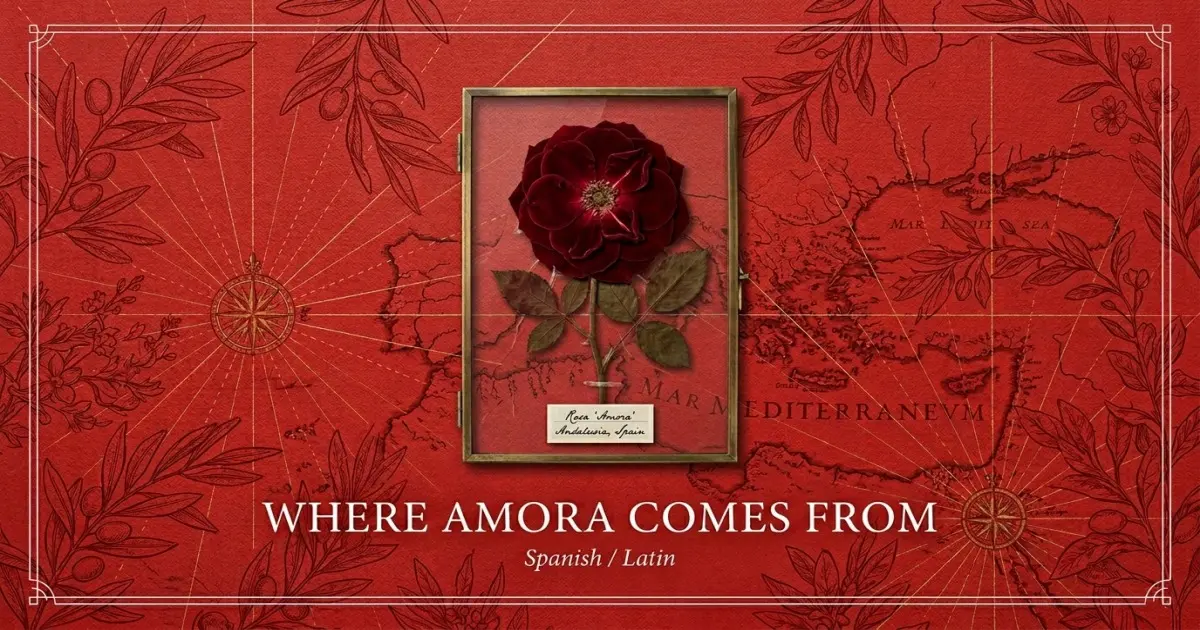
The Latin connection also broadens the meaning in useful ways. Love in the older literary and philosophical sense is not only romance. It can imply care, attachment, devotion, harmony, and the force that binds people into relation. That wider horizon keeps Amora from sounding too narrow. The name can suit a child whose parents hear it spiritually, poetically, or simply humanly. It is not limited to one emotional script.
There is a subtle literary bonus here too. In Spanish literary tradition, love is often tied not only to desire but to order, harmony, and agreement. That gives Amora a more disciplined emotional aura than some other love names might have. It does not suggest chaos or drama first. It suggests connection. That makes it feel more stable and more adult than a casual observer might assume from its softness alone.
All of this helps explain why Amora does not feel flimsy beside more established Romance-language names. It belongs to the same larger cultural world of names shaped by Latin inheritance, but it carries a meaning so immediate that even people with no language background can feel its center at once. That combination of accessibility and depth is rare.
Amora sounds romantic because the stress falls in the heart of the name
Phonetically, Amora is more disciplined than it first appears. Pronounced uh-MOR-uh, it begins lightly, blooms in the middle, and resolves softly at the end. The central stress on MOR is what gives the name weight. Without that stressed middle syllable, the name could sound too airy or diffuse. With it, the name gains shape. The emotional warmth of the meaning is held inside a sound pattern that has clear balance and direction.
This is one of the reasons Amora works better than some other soft, open-vowel names. The beginning syllable is intentionally modest. It does not try to dominate. The middle does the real work, giving the name its pulse. Then the final syllable relaxes the line instead of cutting it off. The result is lyrical, but not loose. The name moves like a small arc rather than a cloud.
There is also a social effect to that stress pattern. Names with strong internal stress often feel more assured in conversation. Amora may be gentle, but it does not drift. In introductions, it lands clearly. In repeated family speech, it remains pleasant. On paper, it looks flowing; spoken aloud, it sounds anchored. That is a very strong combination for a modern name.
Its consonants help as well. The m and r sounds warm the center of the name without making it heavy. The final open vowel keeps the ending soft. This is not a name built on sharp contrasts. It is built on continuity. But because the middle syllable is stressed, that continuity never becomes shapeless. The whole structure quietly reinforces the meaning: something emotionally warm, but still held together.
Why Amora feels current without sounding disposable
Official Social Security Administration (SSA) data shows Amora at No. 285 for girls in 2024, which is almost exactly where one would expect a name like this to sit. It is visible enough to feel socially plausible, but not so common that it loses distinction. For many parents, that is the ideal zone. They want a name that people can hear and remember, yet one that still sounds chosen rather than inherited from mass fashion. Amora occupies that space very effectively. If you are building a shortlist around names like Amora, browse more girls’ names to explore.
Its contemporary appeal is easy to understand. It is emotionally resonant, vowel-rich, feminine, and easy to pronounce once heard. It also shares some of the modern appetite for names that sound internationally fluid without being hard to spell. Yet what keeps Amora from feeling disposable is the fact that it means something clear and ancient. It does not depend on trend alone. Trend may help explain why people notice it now, but the name itself has enough semantic and phonetic integrity to survive beyond a moment.
That matters because many names rise quickly for sonic reasons and fall just as quickly when the sound changes. Amora has a better chance of staying interesting because the meaning continues to matter even after the style cycle moves on. Love is not a seasonal idea. The name’s success depends less on novelty than on the fact that it wraps a permanent human value inside a form that happens to sound very contemporary.
There is also a useful social balance in how the name feels. Amora is warmer than some of the cooler modern favorites, but it does not tip into fussiness. It is more emotionally direct than many abstract style names, but it is not so literal that it becomes embarrassing. That middle position is difficult to achieve, and it is a large part of the name’s strength.
Amora lives beside other love names without disappearing into them
One way to understand Amora more clearly is to place it next to other names built around the idea of love. Across naming traditions, there are many such forms: some literal, some devotional, some softened by history. The difference is that Amora does not sound like a direct English word-name such as Love, nor does it rely on diminutive sweetness the way some pet-name-derived forms do. It comes to the idea through Romance-language structure, which gives it more polish and a little distance.
That distance is important. A name meaning love can easily become too explicit, leaving no room for the child herself to fill it with character. Amora avoids that because the meaning is legible but not blunt. People hear warmth before they hear lesson. They hear elegance before they hear translation. That allows the child to grow into the name instead of feeling pinned beneath it.
Amora also benefits from sounding complete on its own. It does not feel like a fragment of a longer formal name, nor like a nickname waiting for expansion. That completeness gives the name adult credibility. It can work on a toddler and it can work on a professional without needing to change its shape. Not every love-derived name manages that. Amora does.
It is also worth noting that the name’s emotional tone is broad enough to support different family readings. Some will hear devotion. Some will hear romance. Some will hear tenderness. Some will simply hear beauty. The best names allow that kind of layered reception without becoming vague, and Amora manages it well.
Three practical paths that open naturally from Amora
Middle names that keep Amora from becoming too soft
Because Amora already carries warmth and lyrical movement, the strongest middle names usually either sharpen it slightly or give it clean structure. A very ornate middle can crowd the first name’s natural grace, while a concise middle often lets Amora keep its emotional center. If you want the full pairing logic behind that contrast, see Amora middle names.
Nicknames that shorten Amora without flattening its romance
Amora has approachable nickname potential, but the best short forms usually preserve the name’s warmth rather than reducing it to something too abrupt. The nickname field works best when it softens the full name without stripping away the very quality that makes it memorable. To see how those different moods shorten in real life, explore Amora nicknames.
Pronunciation that makes Amora sound more grounded than dreamy
uh-MOR-uh is simple once heard, and the stress on the middle syllable is the key. That middle emphasis is what keeps the name from becoming overly hazy in fast speech. It gives the sound line its backbone. If you want the full sound pattern behind that rhythm, read Amora pronunciation guide.
Why Amora stays larger than its simplicity
In the end, Amora succeeds because it understands something many love names do not: love is strongest when it is not merely declared, but embodied. The name does not need extravagance to make its point. Its root is ancient, its sound is warm, and its shape is disciplined. It offers one of the most universally appealing meanings in human language, but it delivers that meaning through a form refined enough to feel adult, elegant, and lasting.
That is why Amora feels more than pretty. Pretty names can fade once the novelty of their sound wears off. Amora has more to lean on than that. It has linguistic ancestry, a clear emotional center, and a pronunciation pattern that gives it steadiness. Its softness is real, but it is not weakness. Its romance is real, but it is not excess. The name suggests affection with backbone, beauty with coherence, warmth with form.
For parents, that may be the most persuasive thing about it. Amora does not ask them to choose between emotion and structure. It offers both at once. It allows love to sound not fleeting, not sugary, but inhabitable. And that is why Amora remains memorable: because it takes the most universal of meanings and makes it feel not vague, but vividly wearable.