
How to Pronounce Amir: Syllables, Stress, and Common Mistakes
The easiest place to hear whether Amir is being pronounced naturally is not a studio recording but an ordinary public room: a teacher pausing over a class list, a barista repeating a name back from a paper cup, a pediatric nurse checking a chart, a soccer coach calling children across a field. Amir is the kind of name that tends to reveal itself quickly in those situations. When it is said well, it sounds fluid, light at the start, and clear at the end. When it is misread, the shift is usually small but noticeable: the wrong syllable gets stressed, the opening becomes too hard, or the ending loses the clean meer sound that gives the name its poise.
That matters because Amir is a short name carrying a great deal of meaning. Official data shows it now sits comfortably within the top hundred U.S. boys’ names, which means many English speakers will already have encountered it in real life. Its rise has likely been helped by one practical advantage: the name is elegant without being difficult. Once a listener hears the correct rhythm—uh-MEER—the whole shape usually settles into place. The pronunciation feels modern, international, and compact, but it also has a very old clarity to it. The sound does not sprawl. It gathers itself and lands.
What the sound of Amir actually asks your mouth to do
| Element | Phonetic Detail | Quick Tip |
|---|---|---|
| Common spoken form | uh-MEER | Keep the first syllable light and let the second syllable carry the name. |
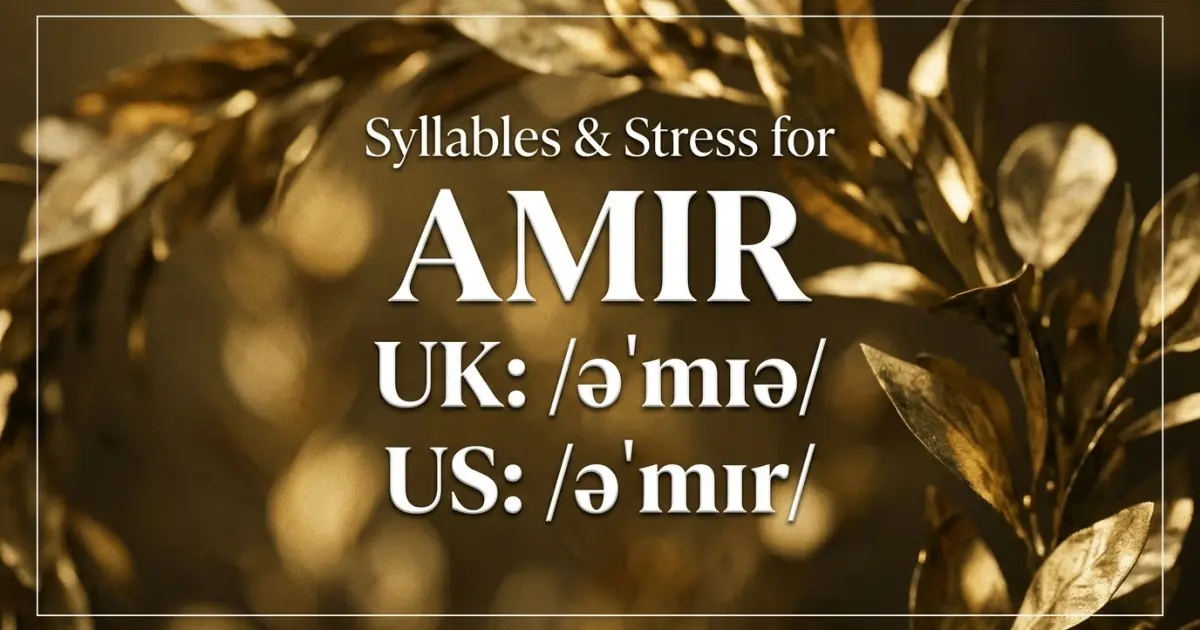
| U.S. IPA | /əˈmɪər/ | In American speech, the ending often glides slightly into an r-colored finish. |
| U.K. IPA | /əˈmɪə/ | In many British accents, the final r disappears and the ending sounds lighter. |
| Syllable count | 2 syllables | Think of it as one soft lead-in plus one strong landing. |
| Stress pattern | Second syllable stressed | The emphasis belongs on MEER, not on the opening A. |
| Opening vowel | /ə/ as in the unstressed sound of “about” | Do not over-pronounce the first syllable; it should sound relaxed, not heavy. |
| Main vowel | /ɪə/ or /ɪər/ depending on accent | The core sound is close to meer, not mare or myer. |
| Most common risk | Wrong stress or a flattened ending | A-MEER is not the same as AM-er; the music of the name matters. |
Amir lives on the second syllable
The most important pronunciation fact about Amir is stress. English speakers often assume short names should land on the first syllable, because that pattern is so common in everyday English. Amir does not do that. It rises. The opening syllable is light, almost like a runway, and the second syllable carries the identity of the name. This is what gives Amir its lifted, elegant contour. If the stress moves to the front, the name immediately sounds flatter and less precise. The sound matters more once you know what the name is meant to carry, which is why the wider frame starts in Amir meaning.
Why the opening of Amir stays soft
The first syllable is usually pronounced with the neutral vowel /ə/, sometimes called the schwa. It is the most common unstressed vowel in English, heard in words like about, sofa, and ago. That matters because it keeps the opening from becoming too formal or too sharp. The name should not begin with a heavy AH in most everyday English use unless a family’s preferred pronunciation clearly does so. In common spoken English, Amir usually starts lightly: uh. The way the name resolves at the end often decides which short forms feel natural in speech, and that becomes clearer in Amir nicknames.
This soft opening also helps the name sound gracious. Linguistically, it means the name does not spend energy too early. It lets the second syllable arrive with more force and more clarity.
Why the ending gives Amir its identity
The second syllable, MEER, is where the name becomes unmistakable. This stressed ending contains the long, clear sound people remember. In American English, that sound often resolves into a slight r-coloring at the end, because many American accents are rhotic. In British English, the r often falls away unless another vowel follows. Even so, the center of the pronunciation stays the same: a focused, bright syllable that sounds close to meer.
This final section of the name is one reason Amir sounds so composed. The ear hears a soft beginning and a precise finish. It is a neat example of how stress can create elegance without length.
Amir changes slightly from American to British speech
One of Amir’s strengths is that its rhythm remains stable across major English accents, even when its ending changes subtly. This makes the name highly portable. A child named Amir does not usually have to live through dramatic pronunciation drift from country to country. Instead, the differences are mostly about how strongly the final r is heard.
Amir in the United States
In American English, the usual form is /əˈmɪər/. The second syllable is stressed, and the ending often carries a faint but audible r. This is because most American accents pronounce written r sounds even at the ends of syllables. That final liquid consonant gives the name a slightly more anchored finish. It can make Amir feel a touch firmer in American speech than it does in many British accents.
Still, the name does not sound harsh. The consonants are smooth, and there are no fricatives—sounds like f, v, or sh that create friction in the mouth. Amir moves mainly through vowels, a nasal m, and a liquid r, which is part of why it sounds graceful.
Amir in the United Kingdom
In many British pronunciations, the form becomes /əˈmɪə/. The stress remains exactly where it should be, but the final r is no longer heard unless a following word invites linking. That makes the ending slightly airier. The name can sound more open and less anchored than in American speech, but not fundamentally different.
This is one of those useful cases where accent differences are genuine but not disruptive. A British speaker and an American speaker may pronounce Amir differently in a technical sense, yet both will sound entirely natural and recognizably correct.
Where Amir is most often misheard or misread
Amir is not a difficult name, but it does have predictable mistake patterns. Most of them come from English speakers trying to force the name into rhythms or vowels that feel more familiar to them. The good news is that the errors are usually easy to correct once the listener hears the proper emphasis.
The most common stress mistake
The biggest error is putting too much weight on the first syllable. When people say AH-mir or something close to AM-er, the name loses its natural rise. It begins to sound either flattened or relocated into another naming system. Because Amir’s identity depends so strongly on second-syllable stress, getting that wrong changes the whole mood of the name.
The simple fix is to think of the name as a soft lead-in followed by a clear finish: uh-MEER. Once that pattern is heard, it is usually easy to keep.
The vowel mistakes Amir can attract
The second common problem is altering the final vowel. Some speakers may drift toward a sound closer to mare, while others may shorten it too much and make it sound clipped. But Amir wants that bright, sustained meer quality. It should not turn into uh-MARE or uh-MIR with a flattened short ending. The stressed syllable needs room to ring a little.
There is also occasional confusion with names that look or sound nearby. Because Amir shares some visual space with names like Ameer, Emir, or Omir in different naming traditions and spellings, listeners sometimes expect more variation than the form actually needs. In everyday English use, however, the most stable and useful guide remains the same: uh-MEER.
Amir becomes easiest when you practice it in full speech
The best way to settle any name into your mouth is to say it in ordinary phrases rather than as an isolated specimen. Amir benefits especially from that method because its rhythm becomes immediately obvious when placed in natural sentences.
Practice lines that make Amir feel automatic
Try saying: This is Amir. Amir is here. Come here, Amir. Amir Daniel. Is Amir ready? In each case, the same pattern emerges: the first syllable stays light, and the second syllable does the naming work. These lines help the rhythm become instinctive rather than studied.
Another useful line is Amir is near. It is not something you would say every day, but it reinforces the sound of the stressed syllable and helps distinguish it from flatter or more front-loaded misreadings.
How to know you are saying Amir naturally
You are close when the name feels smooth, lifted, and unforced. If it feels clipped, heavily front-loaded, or overly theatrical, simplify. Amir is not a name that needs emphasis to sound important. Its authority comes from proportion. The correct pronunciation should feel balanced enough to use in ordinary conversation without any self-consciousness at all.