
Allyson Name Meaning: Origin, Vibe, and Timeless Appeal
Some names inherit nobility so heavily that they feel ceremonial before the child has even spoken. Allyson does something more interesting. It carries a noble meaning, but it does not sound remote, cold, or aristocratic. It sounds companionable. That is the central tension that gives the name its staying power: the idea behind it is elevated, but the voice of it is familiar. In three easy syllables, Allyson turns an old social ideal into something more intimate and human-sized. It does not arrive wearing a crown. It arrives in conversation.
That distinction matters. “Noble” is one of the most enduring meanings in European naming, but parents rarely choose it because they want grandeur in the theatrical sense. What they often want instead is character: dignity without stiffness, self-respect without vanity, warmth without plainness. Allyson is unusually good at carrying that combination. The spelling feels gently individualized, the pronunciation is stable and clear, and the overall impression is polished without being brittle. The name’s real achievement is not that it sounds grand. It is that it makes nobility sound livable.
Allyson's U.S. popularity rank over time, 1945–2024
Popularity statistics are based on official data from the Social Security Administration baby name records.
Allyson: A Reliable and Noble Heritage Classic
Allyson presents a chart pattern of a broader past with a clearer present, reflecting high naming momentum in 1998 that now offers long-running cultural familiarity. It continues to be a “safe but polished” choice that parents trust for its enduring light and professional feel.
While historical traces exist for boys, the modern era defines it as a primarily feminine staple. Meaning “noble,” its simple three-syllable rhythm remains both durable and widely trusted across generations.
What Allyson Shows Before the Full Story Begins
| Key Facts | Information | Quick Insight |
|---|---|---|
| Name | Allyson | The spelling feels familiar but slightly personalized, which helps the name stand apart without becoming hard to recognize. |
| Gender Usage | Female | Its sound and usage now read clearly feminine in everyday English-speaking contexts. |
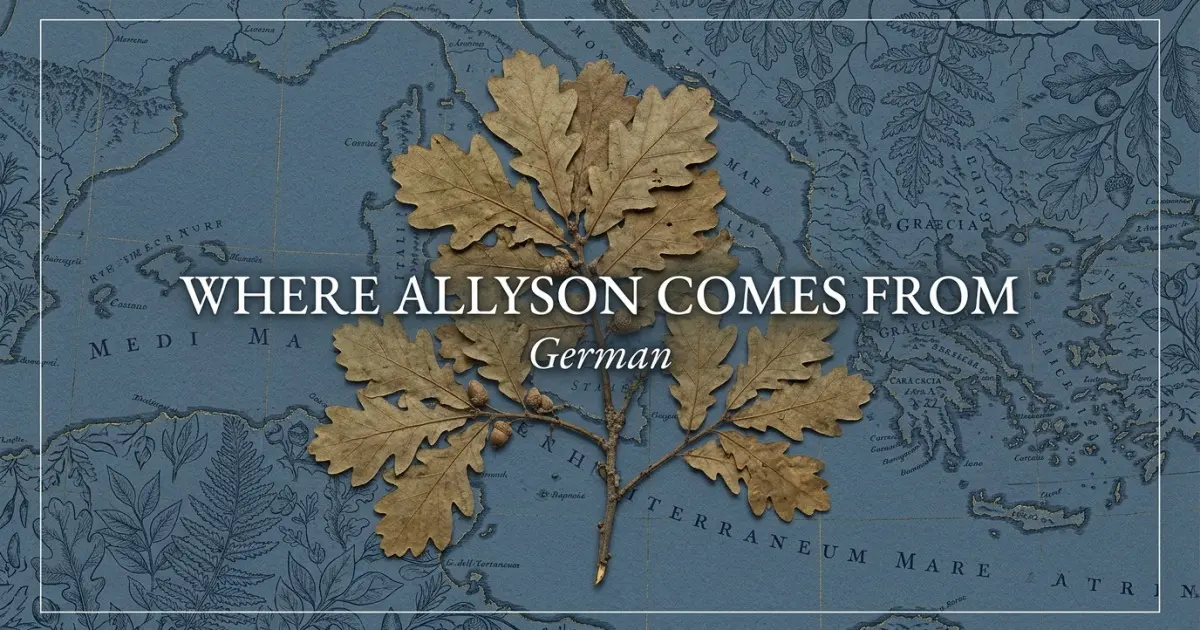
| Origin | German | The name draws from an older European tradition in which noble status became a lasting naming ideal rather than a literal title. |
| Meaning | Noble | This is a compact meaning with unusual durability: it signals dignity, bearing, and social grace rather than ornament. |
| Pronunciation | AL-ih-sun | The rhythm is straightforward and natural, which lets a more distinctive spelling stay socially easy. |
| IPA | US: /ˈælɪsən/ • UK: /ˈælɪsən/ | The shared American and British form reduces uncertainty and helps the name travel cleanly across accents. |
| Syllable Count | 3 | Three syllables give Allyson enough movement to feel graceful, but not so much that it becomes elaborate. |
| U.S. girls’ rank (2024) | No. 909 | Official data places it in the zone where a name feels known, yet still uncommon enough to remain personally distinctive. |

Allyson Makes Nobility Feel Personal Rather Than Distant
The strongest thing about Allyson is that its meaning does not overpower its tone. Many names associated with high birth, royal bearing, or historic rank can feel visibly formal. They may be beautiful, but they also arrive with social distance built into them. Allyson avoids that problem. The word “noble” remains at its center, yet the sound of the name is domestic, bright, and approachable. That combination is why the name works so well in modern life. It does not ask the child to perform grandeur. It asks for steadiness, grace, and good presence.
That is an important shift in how older naming meanings are heard now. Historically, noble language could point toward rank and bloodline. In contemporary naming, it is far more often interpreted as temperament. Parents hear “noble” and think of qualities that are moral or social rather than hereditary: decency, strength of character, self-command, composure, kindness with backbone. Allyson carries exactly that updated reading. It suggests a person who is not flashy, but who has internal order. Not someone above others, but someone able to meet the world with poise.
The name’s warmth is what protects it from pomposity. The opening Al- is open and friendly. The middle vowel keeps the name moving. The final -son gives it structure. Together they create a word that sounds grounded rather than ornamental. You can hear this in everyday use. Allyson sounds perfectly at home in a classroom, on a résumé, in a family kitchen, or introduced at a formal event. Some noble names belong more clearly to one register than another. Allyson has broader social range because its dignity is softened by familiarity.
That makes it appealing to parents who want a meaning with backbone but do not want a name that feels stiff or overcostumed. Allyson is neither antique nor aggressively modern. It offers character without costume drama. In a naming culture that often swings between severe minimalism and highly decorative novelty, that balance is not a small thing. It is the name’s central achievement.
How Allyson Carries an Older Noble Root Through a Contemporary Spelling
Modern naming references commonly place Allyson in the Alison family, and Alison itself is usually treated as belonging to the wider Alice line. Across that family, the core idea remains strikingly consistent: nobility, sometimes expanded into shades such as “noble” and “exalted” or “noble” and “kind.” That continuity matters more than any single spelling. It means Allyson is not a detached modern invention. It is a contemporary surface laid over an older current of meaning.
That older current helps explain why the name feels settled even when the spelling feels slightly personalized. The y in Allyson does not create a new meaning. It changes the visual texture. In practice, that makes the name feel more tailored to modern English-language taste, where variant spellings are often used to make a familiar name feel a little more singular. But because the root meaning remains intact, Allyson does not lose its historical gravity. It is a good example of how spelling can modernize a name’s appearance without severing its inherited character.
This is also where the name becomes culturally interesting. Some names feel strongest when their oldest form is used without alteration. Others survive quite comfortably through a range of spellings because their identity lives more in sound and meaning than in one exact letter pattern. Allyson belongs to the second group. Its spelling may shift across Alison, Allison, Allyson, Alyson, and nearby forms, but the ear still hears the same general character: familiar, feminine, dignified, and socially easy. That kind of flexibility often helps a name endure. It can adapt to different decades without becoming unrecognizable to itself.
The result is a name that feels rooted but not rigid. Parents who choose Allyson are often choosing that double effect whether they say so explicitly or not. They are reaching for an old, respected meaning, but through a form that feels closer to the present. The name’s history matters, yet it does not trap the child in period costume. It keeps the inheritance and updates the handwriting. If the origin of Allyson is part of its appeal, you may also like related names by origin.
Allyson Lives in the Narrow Space Between Familiarity and Distinction
A great many names fail because they solve only one problem. Some are memorable but difficult to carry. Others are easy but too generic to feel intimate. Allyson occupies a narrower and more useful middle ground. It is readable on first sight, sayable on first hearing, and uncommon enough in current ranking data to avoid the fatigue that can come with more crowded choices. At No. 909 for girls in the United States in 2024, the name sits in a revealing position: visible, but not saturated. If you want to branch out from Allyson without leaving this category, explore browse girl names.
That placement gives Allyson one of its strongest practical advantages. It does not sound alien, yet it is unlikely to feel overdistributed in the average peer group. Parents often underestimate how powerful that combination is. A name that people already understand tends to move more smoothly through social life. A name that is still rare enough to be individualized tends to feel more personal over time. Allyson benefits from both conditions. It can be introduced without explanation, but it still has room to belong closely to its bearer.
The spelling plays a large role here. Allyson is clearly related to more familiar neighboring forms, which means it borrows some of their social legibility. At the same time, the y visually distinguishes it just enough to register as a deliberate choice. That difference is small, but not trivial. Naming is full of such small decisions. One vowel, one consonant, one alternate letter can shift a name from generic to specific. Allyson demonstrates that principle well. It is not a radically altered form. It is a lightly edited one, and that lightness is exactly why it works.
Research and long-standing naming advice have often emphasized that a child’s name must function across many settings: school, work, adulthood, official documents, friendships, and family speech. Allyson performs well in that wider test. It can sound polished without being severe, warm without being diminutive, current without being time-stamped. That is a rare social flexibility, and it helps explain why the name can feel simultaneously established and fresh.
The Sound of Allyson Adds Softness to a Strong Meaning
If the meaning of Allyson gives the name its moral shape, the sound of Allyson gives it emotional shading. AL-ih-sun is a three-syllable pattern with a clear opening stress. The first syllable lands firmly, which gives the name confidence. The second syllable softens that impact. The final syllable resolves the word in a familiar, unforced way. Nothing in the pronunciation is jagged or overcomplicated. This matters because names built around strength-related meanings often risk sounding too hard. Allyson avoids that. Its sound makes the noble meaning feel humane.
Phonetically, the name is full of cooperative English sounds. The opening vowel is broad and immediate. The liquid l helps the first syllable move smoothly into the middle. The final -sun is stable and plainspoken. Even the full three-syllable length is useful: it gives the name enough space to feel elegant without becoming ornate. Shorter names can sometimes make a lofty meaning sound abrupt. Longer ones can sound ceremonial. Allyson settles into a middle register that is easier to inhabit.
This is also why the name supports multiple social moods. In full form, Allyson sounds composed and complete. In casual use, it naturally invites softer short forms such as Ally or Ali without losing its base identity. That elasticity is part of its appeal. The full name carries dignity; its everyday possibilities carry warmth. The two are not in conflict. They help each other.
Because the American and British IPA forms are the same in the supplied profile, the pronunciation is also unusually stable across major English accents. That may sound like a technical footnote, but it has real social value. A stable name is easier to carry publicly. It asks less correction from the child and gives more confidence to the speaker. Allyson’s familiarity in the mouth reinforces the meaning on the page: noble, yes, but socially graceful.
Allyson Belongs to a Style Family That Explains Its Appeal
Names are never heard in isolation. They are heard beside neighboring names, and those neighbors shape perception. Allyson lives near Alice, Alison, Allison, Alicia, Alyssa, and other names that mix softness with established feminine use. That neighborhood is helpful because it tells us what kind of distinction Allyson offers. It is not trying to reject tradition. It is working inside tradition, but with a slightly more individualized outline.
Compared with Alice, Allyson feels more contemporary and less spare. Compared with Alison, it feels visually personalized. Compared with Allison, it can look a little less standard and a little more intentionally styled. Compared with Alyssa, it feels steadier and less overtly late-modern in flavor. These are fine distinctions, but naming choices are often made at that level. Parents are not always deciding between completely different categories. They are often deciding between neighboring moods.
In that respect, Allyson’s style position is especially interesting. It combines the warmth of accessible late-twentieth-century naming with an older, more durable meaning. It can satisfy parents who want something familiar but not automatic, feminine but not fragile, polished but not precious. The name’s closest relatives help clarify its voice. It is softer than severe classics, calmer than highly embellished variants, and more rooted than trend names built only from sound.
That rootedness matters because it gives the name a longer horizon. Names survive better when they are attached to a durable emotional idea, not just a fashionable arrangement of letters. Allyson has that durability because “noble” is a meaning deep enough to keep translating across time, while the sound stays approachable enough for everyday life.

Where Allyson Opens into the Rest of the Story
Middle names that sharpen or soften Allyson
Because Allyson is already full and rhythmically balanced, the best middle names usually do one of two jobs: they either give it a cleaner edge through brevity, or they deepen its elegance through something more traditional and stately. The full combination depends less on decoration than on balance. If you want the full pairing logic behind that contrast, see Allyson middle names.
Nicknames that make Allyson more intimate
One reason the name remains socially flexible is that its shorter forms are natural rather than forced. Allyson can stay fully formal in public life, then soften easily in family or friendship circles. That built-in intimacy is part of the name’s enduring appeal. To see how those different moods shorten in real life, explore nicknames for Allyson.
Pronunciation that keeps Allyson clear and stable
AL-ih-sun is a steady, low-friction pronunciation. It has enough syllabic movement to feel graceful, yet almost no ambiguity once heard. That ease helps the more distinctive spelling feel socially manageable rather than burdensome. If you want the full sound pattern behind that rhythm, read how to pronounce Allyson.
Why Allyson Still Feels Like Allyson
What finally distinguishes Allyson is not just its meaning, its spelling, or its ranking, but the way those elements cooperate. The name carries a noble idea without becoming lofty, a familiar sound without becoming generic, and a personalized spelling without becoming unstable. That is a difficult balance to achieve. Many names do one of these things well. Fewer do all three.
In literary terms, Allyson is a name with good proportions. The first impression is warm. The inherited meaning adds depth. The variant spelling adds a touch of authorship. Nothing in it is excessive. That restraint is part of the elegance. A noble name can fail by trying too hard to appear noble. Allyson succeeds because it trusts the meaning to work quietly underneath the surface. It does not insist on importance. It carries it.
That is why the name remains compelling even at low current visibility. Official data shows it is uncommon, but it does not feel obscure. It belongs to a family of names people already know how to hear, yet it keeps enough individuality to feel chosen rather than defaulted. For many parents, that is exactly the sweet spot: a name with history, character, and social ease, but still enough air around it to become one child’s own.
And that may be the most faithful way to understand Allyson. It is not nobility as spectacle. It is nobility as bearing. A name that sounds lived in, not staged. A name that can move through ordinary life while keeping an older ideal intact. Allyson does not need to announce its dignity loudly. It carries it in the quieter, harder way: by making it believable.