
How to Say Allison Correctly: How the Name Is Usually Said

Allison is the kind of name that usually enters a room before anyone thinks very hard about it. A teacher reaches it on a class list and says it almost in one breath. A receptionist calls it from a waiting room without hesitation. A coach shouts it across a field and expects it to carry. That ease is part of Allison’s identity. It is familiar, socially fluent, and rarely treated as a pronunciation puzzle. Yet that very familiarity can make people careless. When a name feels ordinary, speakers often stop hearing its structure. With Allison, the structure matters, because the name sounds warm and approachable precisely because the stress, vowels, and softened ending are doing careful work.
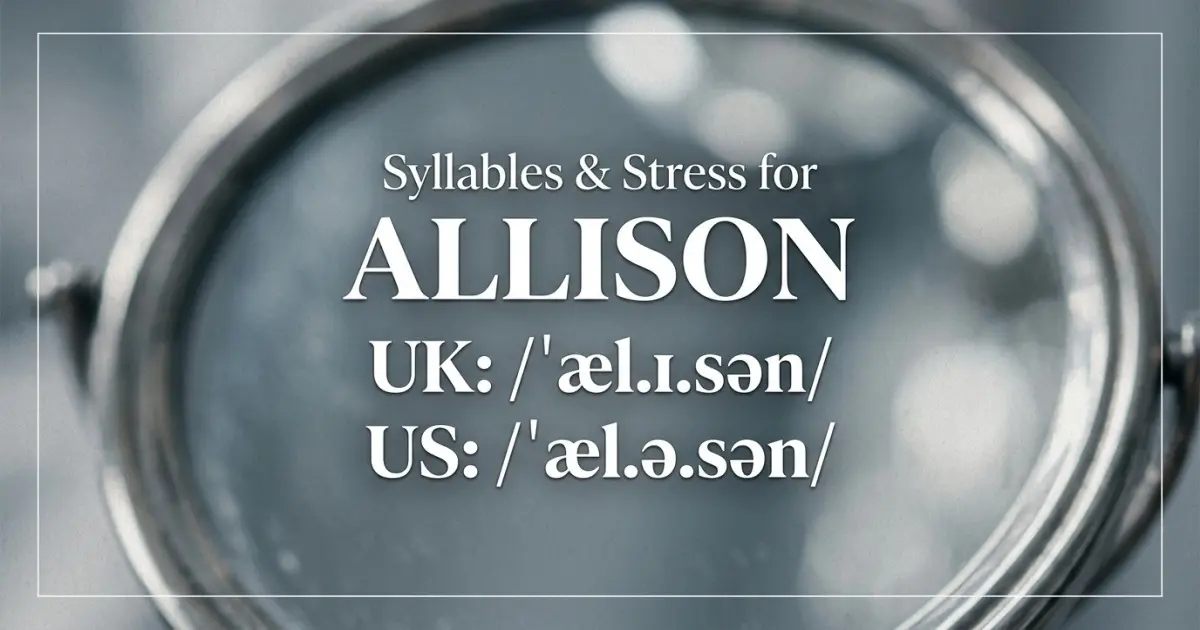
The everyday pronunciation given here is AL-i-suhn, and the IPA for both US and UK English is /ˈælɪsən/. That tells you something important immediately: the name is stable across major English accents. Allison does not dramatically shift its identity from one region to another. It begins with a clearly stressed first syllable, moves through a lighter middle, and lands on a soft, almost relaxed final syllable. The result is a name that sounds dependable without sounding heavy, feminine without sounding fragile, and familiar without becoming shapeless.
What Allison is actually doing when Allison is said well
Allison works because the opening carries the name and the ending lets it settle. It is not a flat three-beat chant. It is a front-led name with a softened finish.
| Element | Phonetic Detail | Quick Tip |
|---|---|---|
| Everyday pronunciation | AL-i-suhn | Keep the first syllable strongest and let the final two fall away more lightly. |
| IPA (US) | /ˈælɪsən/ | The stress mark shows that Allison’s identity sits in the opening syllable. |
| IPA (UK) | /ˈælɪsən/ | The same IPA means the core sound pattern stays highly stable across American and British English. |
| Syllable count | 3 syllables | Think AL + i + suhn, not a rushed two-syllable blur. |
| Stress pattern | First syllable stressed | The name should feel front-weighted, not evenly spread across all three syllables. |
| Ending sound | -suhn | Keep the last syllable soft and conversational rather than clipped or over-enunciated. |
Why Allison sounds warm instead of severe
Allison begins firmly, but it does not stay hard. That balance is the reason the name has lasted so well. A stronger opening gives it confidence. The lighter later syllables make it socially easy. Together they create a name that feels composed without ever sounding rigid. Pronunciation lands more fully when the name’s roots and history are already in view, so begin with Allison meaning.
The opening of Allison gives the name its steadiness
The first syllable, Al-, carries the main stress, and that stress matters. It makes the name sound settled and self-possessed. In phonetic terms, the short open vowel in /ˈæl/ is direct and recognizable, which helps Allison land clearly in the ear. This is one reason the name works so well in daily life. It does not require the listener to wait until the end to understand what was said. The identity of the name arrives early.
This early clarity also helps Allison sound mature. Names with weak or blurred openings can sometimes feel uncertain or overly delicate. Allison avoids that. It starts with enough structure to feel dependable, which suits the meaning behind the name very well.
The middle and ending of Allison soften the line
After the firm opening, Allison relaxes. The middle syllable is lighter, and the final -suhn is softer than a more sharply pronounced ending would be. The final syllable is not meant to hit hard. It should almost settle into the sentence. That soft landing is part of what makes Allison feel friendly. The name begins with confidence and ends with ease.
This soft descent is socially useful. It means Allison can sound polished in formal settings and still remain warm in everyday speech. That is one reason the name has remained durable across generations. The pronunciation already knows how to be both serious and approachable at once.
Allison in American and British English keeps the same core shape
Some names change meaningfully between US and UK pronunciation. Allison is not one of them. Here, the IPA is the same in both versions, which means the stress, syllable structure, and major vowel pattern remain stable. That kind of consistency is one of the name’s quiet strengths.
Accent differences exist in texture, not identity
An American speaker may make the first vowel a little brighter or the final syllable a touch more relaxed depending on region. A British speaker may smooth certain vowel edges differently in connected speech. But these are accent textures, not structural changes. Allison still sounds like Allison. The first syllable remains the anchor, and the ending still softens.
This matters because a stable pronunciation makes a name easier to carry across schools, workplaces, travel, and international contexts. Allison does not need to reinvent itself in different English-speaking settings. It already travels well.
Why Allison feels easier to say than it looks
On the page, Allison has enough letters to look slightly more complicated than names like Anna or Claire. But in speech, it is straightforward because the stress pattern is clear and the consonants are familiar. There are no difficult clusters, no hidden syllables, and no unstable vowel debates in the form given here. Once heard once, the pronunciation tends to stay fixed in memory.
Where Allison most often gets bent out of shape
Because Allison feels familiar, the most common mistakes come from rushing or flattening it rather than from real confusion. People tend to reduce it, over-soften it, or blur it with neighboring names when they stop listening carefully.
The most common mistake is flattening all three syllables
If Allison is spoken with equal stress on every syllable, the name loses much of its grace. It should not sound like three identical beats. The first syllable carries the identity, while the later syllables should be lighter. A flattened Allison sounds more mechanical and less natural.
Another mistake is over-pronouncing the final syllable
The ending should be soft. If the -suhn is spoken too heavily, the name can begin to sound stiff or unnatural. The final syllable is supposed to support the first, not compete with it. Allison’s friendliness depends partly on letting the ending relax.
Sound neighbors can cause momentary confusion
Allison lives near names such as Alice, Alyssa, and Addison in the English-speaking ear. That means a distracted listener can sometimes place it in the wrong name family for a second, especially in noisy settings. The easiest correction is to keep the first syllable strong and the overall rhythm clear. Once the name is heard as AL-i-suhn, it tends to correct itself quickly. Because the strongest energy lands early, the shorter forms often grow from the opening of the name, and that pattern is easier to see in Allison nicknames.
How Allison sounds best in real speech
The easiest way to say Allison well is to treat it as a name that opens clearly and then settles naturally. Do not overcare for it. Do not rush it flat. Let the first syllable do its job, and let the rest follow.
Start with the frame: AL + i + suhn
Say AL clearly. Then move quickly through the lighter middle syllable. Finish with a relaxed suhn. Put together, the name should feel like one natural spoken unit: AL-i-suhn. The first syllable should sound confident. The rest should sound easy.
This is one reason Allison is such a wearable name. It does not ask for performance. It asks only for balance.
Use practice lines instead of isolated repetition
Names settle into the mouth more naturally inside real sentences. Try these aloud:
Allison is here.
I saved this for Allison.
Allison will join us later.
These lines help preserve the front stress and keep the ending light. They also show why the name works so well socially. It moves through ordinary English speech without friction.
Listen for clarity with warmth
The best pronunciation of Allison sounds clear, steady, and relaxed. It should not sound overly clipped, and it should not sound over-careful. Strong opening, softer continuation, gentle finish. That is the rhythm that makes Allison feel both noble in meaning and human in daily use.
Common Questions About How Allison Sounds
How do you pronounce Allison in everyday English?
Allison is usually pronounced AL-i-suhn, with the main stress on the first syllable.
What is the IPA for Allison?
The IPA shown here is /ˈælɪsən/ in both US and UK English.
Does Allison sound different in the US and UK?
Not in any major structural way. Small accent textures may vary, but the core pronunciation remains the same.
What is the most common pronunciation mistake with Allison?
The most common issue is flattening all three syllables or overemphasizing the final syllable instead of letting the name stay front-weighted and relaxed.
Is Allison an easy name for English speakers to say?
Yes. Allison is generally very easy to pronounce because its stress pattern is clear, its sounds are familiar, and its rhythm fits natural English speech well.