
Alice Name Meaning: Why the Name Still Feels Relevant Today
Alice is one of the rare names that has managed to keep its original dignity while becoming almost weightless in daily speech. It began in a naming world that cared deeply about rank, lineage, and inherited standing, and yet modern ears do not hear Alice as aristocratic display. They hear clarity, intelligence, and composure. That is the central achievement of the name. It takes an old idea—nobility—and makes it feel inward rather than ornamental. Alice does not sound like a title. It sounds like character.
That is why the name has lasted across centuries without needing reinvention. Historically, it belongs to the long European tradition of names built from moral or social ideals. But unlike heavier antique names that remain trapped in costume drama, Alice crossed into ordinary use and stayed there. Medieval England knew it. The nineteenth century renewed it. Literature gave it a dreamlike afterlife. Modern parents still return to it because it offers something difficult to manufacture: grace without fragility, familiarity without plainness, and refinement without distance. In Alice, nobility stops being a social category and becomes a style of presence.
Alice's U.S. popularity rank over time, 1880–2024
Popularity statistics are based on official data from the Social Security Administration baby name records.
Alice: A Noble Literary Classic
Alice reads as a name with one unmistakable center of gravity, with the girls’ side of the chart carrying most of its long-term visibility and familiarity. Its durability often reflects a preference for “vintage revivals” that offer a sense of literary polish and a soft, two-syllable rhythm .
The lighter lane for boys has remained largely inactive in the modern era, leaving the name with clear feminine clarity. Meaning “noble,” Alice benefits from an elegant structure that allows it to feel classic without becoming heavy.
Alice in one well-lit frame
| Key Facts | Information | Quick Insight |
|---|---|---|
| Name | Alice | Short, finished, and unmistakable, Alice needs no embellishment to feel complete. |
| Primary Gender Usage | Female | Its modern identity is overwhelmingly feminine, even though official records show occasional rare use for boys. |
| Origin | Germanic | The name comes from an older European naming tradition where names often carried social and moral meaning rather than simply pleasing sound. |
| Core Meaning | Noble | The appeal lies in how the meaning reads today: less about class, more about self-command, ethics, and poise. |
| Pronunciation | AL-is | Its pronunciation is clean and stable, which helps the name travel easily across generations and settings. |
| IPA (US) | /ˈælɪs/ | The crisp opening and soft ending give the name both clarity and gentleness. |
| IPA (UK) | /ˈælɪs/ | The near-identical British and American form strengthens Alice as an international English-language classic. |
| Syllable Count | 2 | Two-syllable names often feel balanced in speech, and Alice is a model of that balance: brief, but never abrupt. |
| U.S. girls’ rank (2024) | No. 62 | Official data places Alice in strong current use while preserving enough distance from overuse to keep its individuality intact. |
| U.S. boys’ rank (2024) | No. 10964 | This confirms how decisively Alice now reads as feminine in modern American naming practice. |
How Alice turns nobility into character
The meaning of Alice is compact, but it is not simple. “Noble” can look like an easy word until you ask what sort of nobility a modern name can still carry. In earlier periods, nobility was tied to birth, hierarchy, and visible social order. Those associations have not vanished entirely, but in contemporary naming culture the word has shifted. Parents who choose Alice are rarely trying to suggest aristocracy. What attracts them is a subtler form of elevation: steadiness, good judgment, seriousness without severity, and grace that does not need applause.
That is one reason Alice ages so well. A noble meaning can sometimes burden a name if the sound is too grand or too ceremonial. Alice escapes that trap because its sound is so orderly and contained. The name does not overperform its meaning. It carries it quietly. That makes the meaning more believable. Instead of sounding like a proclamation, Alice sounds like a standard someone might actually live up to.
There is also a useful tension inside the name. Nobility can imply distance, but Alice rarely feels distant. It feels near, readable, and humane. That paradox gives it unusual depth. The name suggests refinement without snobbery. It can belong to a child, a scholar, an artist, a judge, or a grandmother without strain. Its dignity is portable. That is often the mark of a durable classic: the ideal inside the name survives because the name itself remains usable.
In this sense, Alice belongs to a family of names that give a child not a costume but a compass. It does not try to pre-write a personality. It simply leans toward a certain kind of bearing. Calm. Intelligent. Self-respecting. Morally centered. If some names promise sparkle and others promise force, Alice promises proportion. It suggests a person who can carry herself well in a room, in a sentence, and in a life. That is a strong inheritance from a single word.
Alice came through French doors but keeps an older Germanic core
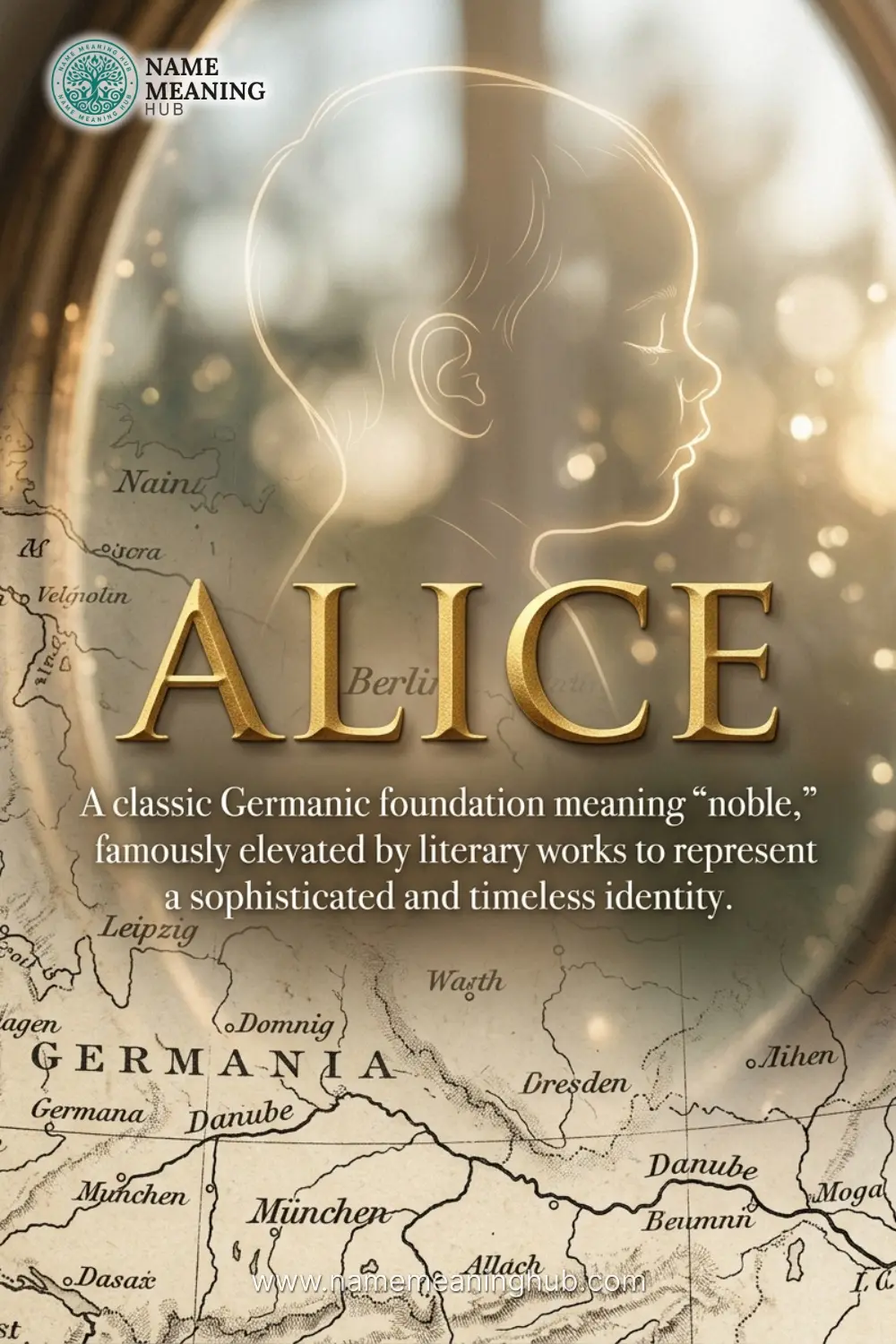
Historically, Alice has never been a flimsy pretty form. The name carries a long route behind it. Naming references place it in English and French use while tracing it back to older Germanic elements associated with nobility. That layered journey matters because it explains why Alice feels both polished and old-rooted. It has passed through refinement without losing its original structure. To keep exploring names from the same background, see a wider list of Germanic names.

Part of the name’s durability comes from that middle stage in French. Names often change character when they move languages. Some become softer, some more elaborate, some more courtly. Alice benefited from that transition. It kept the older noble core, but the spoken form became cleaner and more graceful. By the time it settled firmly into English use, the name no longer sounded purely ancestral. It sounded civilized in the broad cultural sense: shaped by use, worn smooth by history, and ready for ordinary life.
Historically, Alice was already established in medieval England. That detail is easy to miss, but it matters. Medieval survival is one of the clearest signs that a name has real structure. Temporary fashions come and go; names that endure through long social change usually possess something stronger than novelty. Alice proved early that it could live in common speech, legal records, family histories, and inherited naming patterns. It was never merely a literary ornament added later. It had life before literature made it iconic.
That older depth also explains why Alice still feels grounded even when it is chosen for aesthetic reasons. Plenty of parents love the name because it sounds clean and elegant, and that is understandable. But underneath that immediate appeal is a much older framework: one of the classic European names built not around image but around value. The ancient impulse behind the name is not decoration. It is rank translated into virtue, and over time that virtue outlasted the rank itself.
After Wonderland, Alice stopped being merely old and became mythic
If medieval history gave Alice roots, literature gave it atmosphere. The great turning point came in the nineteenth century, when the name re-entered cultural imagination with new force. Naming references note that Alice enjoyed a surge of popularity in that century, and the timing is revealing. This was the era in which old names were being re-seen through the lenses of childhood, sentiment, fantasy, and print culture. Alice was perfectly positioned for that moment because it already had pedigree, simplicity, and melodic clarity.
Then came its most famous literary transformation. With Alice’s Adventures in Wonderland in 1865, Alice ceased to be merely a historic girl’s name and became one of literature’s permanent first names. That change is hard to overstate. Some books make a character memorable; a few books permanently alter the atmosphere around a name. Alice is one of those cases. After Wonderland, the name carried not only nobility and history, but also curiosity, intelligence, inward poise, and a certain brave willingness to move through absurdity without losing selfhood.
This literary layer works especially well because it does not erase the older meaning. It expands it. The Alice of cultural memory is not noble in a ceremonial sense. She is noble in the modern, moral sense: observant, self-possessed, and able to remain herself in a disorienting world. That is why the literary association has stayed fresh instead of becoming dusty. It adds imagination without making the name whimsical beyond repair.
Importantly, Alice also avoided the trap that catches some heavily literary names. It did not become unusable outside the book. The novel made the name richer, but ordinary families kept using it. That practical continuity saved Alice from turning into a museum piece. It remained a real name with a real life, which is why its literary prestige still feels like an enhancement rather than a burden.
Why Alice still sounds intelligent, gentle, and complete
Phonetically, Alice is almost a lesson in restraint. The opening syllable lands clearly, the second recedes lightly, and the whole name ends on a soft hiss rather than a dramatic flourish. That sound pattern contributes enormously to how the name is perceived. Alice feels articulate without sounding sharp, soft without becoming vague, and feminine without excessive decoration. The result is a name people often read as intelligent before they even analyze why.
Part of that impression comes from the lack of excess. Alice does not rely on extra syllables, ornamental endings, or trendy sounds. It is trimmed to essentials. That makes it feel lucid. In a classroom, on a book spine, on a business card, or spoken across a dinner table, Alice has an unusual quality of visual and auditory neatness. It looks the way it sounds. Names with that level of alignment often feel trustworthy.
Socially, Alice occupies an enviable middle ground. It is undeniably classic, but it does not feel frozen. It can sit comfortably beside old-fashioned revivals and beside cleaner modern favorites. It is at home with names chosen for literary depth, with names chosen for family continuity, and with names chosen simply because they are beautiful and practical. That versatility helps explain why Alice keeps returning in every new generation of stylish classics.
The name also benefits from a certain emotional neutrality in the best sense. Some names arrive already loaded with glamour, toughness, sweetness, or trend-conscious cool. Alice arrives with more room. It can become bookish, artistic, graceful, witty, serious, warm, or quietly formidable depending on the person who wears it. That flexibility is one of the reasons classic names survive. They do not trap identity; they accommodate it.
Alice in today’s records and tomorrow’s conversations
Official Social Security Administration (SSA) data shows Alice at No. 62 for girls in the United States in 2024. That is a revealing position. It places the name comfortably inside current use, but not in the narrow zone where overexposure can flatten a name’s distinctiveness. Alice is familiar, but still feels chosen. That balance is attractive to many parents because it offers recognition without predictability. Most people know the name instantly. Far fewer feel tired of it. You can also compare Alice with other choices in girl naming ideas.
Its current standing also says something about the kind of revival Alice represents. This is not a comeback built on novelty or irony. It is not being worn as costume vintage. Alice returns because it solves modern naming problems elegantly. It is easy to pronounce, easy to spell, historically rich, emotionally balanced, and culturally durable. Many names succeed on two or three of those counts. Alice succeeds on nearly all of them.
Middle names after Alice usually work best when they add depth, not sweetness
Because Alice is already clean and self-contained, the best middle names often add length, gravity, or family texture rather than more delicacy. A stronger or more expansive middle can keep the full combination from becoming overly airy. If you want the full pairing logic behind that contrast, see Alice middle names.
Nicknames for Alice matter less for shortening than for social tone
Alice is short enough to stand on its own, so nickname decisions are usually about intimacy and mood rather than necessity. That makes the name especially interesting in family life: it is complete in public, but still flexible in private. To see how those different moods shorten in real life, explore Alice nicknames.
Pronouncing Alice is simple, but its elegance comes from the exact sound balance
The pronunciation is straightforward, yet the effect depends on proportion: the clear first syllable, the lighter second syllable, and the soft ending all help explain why the name feels poised rather than plain. If you want the full sound pattern behind that rhythm, read Alice pronunciation guide.
Why Alice still feels like Alice
The deepest strength of Alice may be that every era has found a slightly different way to understand it without breaking the name itself. In an older world, it could still carry the echo of noble birth. In the literary nineteenth century, it became a name of curiosity and inner composure. In the present, it often reads as intelligent, graceful, and assured. The surface interpretation changes. The core remains. That is usually how true classics work: they keep their center while allowing culture to see new things in them.
Alice also achieves something many names aim for and few fully manage. It sounds gentle without sounding weak. It sounds cultivated without sounding pretentious. It sounds feminine without being fragile. The noble meaning helps hold all of that together. Nobility, in the best reading of the name, is not about being elevated above others. It is about the quality of one’s manner, ethics, and self-command. Alice makes that old idea feel both intimate and contemporary.
In the end, Alice endures because it is more than lovely. It is exact. It offers history without heaviness, literature without theatricality, and elegance without frost. It can belong to a child learning to speak, to a woman signing her name, to an elder whose presence quiets a room. Very few names can travel that whole distance while remaining unmistakably themselves. Alice can. That is why it continues to feel less like a trend than a standard: not loud, not decorative, but quietly noble in the way the best names are.