
Alaia Name Meaning: Roots, Vibe, and Cultural Backdrop
Some names try to describe joy by sounding extravagant. Alaia does something harder. It makes joy sound light on its feet. The supplied meaning, “joyful; happy,” could easily lead to a name that feels sugary, noisy, or overbright. Instead, Alaia arrives with a kind of quiet lift. It does not sparkle in a crowded way. It opens, rises, and disappears cleanly into air. That is the central mystery of the name: its emotional meaning is generous, but its sound is restrained. The result is a name that suggests happiness not as performance, but as atmosphere.
That balance explains much of Alaia’s appeal in modern use. Official Social Security Administration (SSA) data shows it ranked No. 112 for girls in the United States in 2024, which places it in a revealing position. It is no longer obscure, yet it still feels chosen rather than automatic. Parents are often drawn to names that sound soft and contemporary but still carry a clear emotional center. Alaia offers exactly that. It belongs to a small but powerful group of names that feel warm without becoming ornate, lyrical without becoming heavy, and modern without sounding manufactured. In other words, Alaia does not just mean happiness. It makes happiness sound plausible in everyday life.
Alaia's U.S. popularity rank over time, 1986–2024
Popularity statistics are based on official data from the Social Security Administration baby name records.
Alaia: A Joyful and Newly Ascendant Basque Choice
Alaia presents as a name with one unmistakable center of gravity, with its visibility concentrated entirely on the girls’ side of the chart. Reaching an all-time peak in 2024, its momentum likely reflects a preference for sophisticated, vowel-rich names that feel distinctive without becoming difficult .
The lack of a secondary track reinforces its strong default feminine identity. Meaning “joyful” or “happy,” its melodic three-syllable sound gives it an elegant texture that remains fresh.
Alaia enters the room already carrying its own weather
| Key Facts | Information | Quick Insight |
|---|---|---|
| Name | Alaia | The name feels airy and current, but its clear meaning gives it more substance than a purely style-driven choice. |
| Primary gender usage | Female | Its present-day use is distinctly feminine, though the sound stays clean rather than overly frilled. |
| Primary origin | Basque | The Basque origin gives Alaia a sense of specificity and cultural shape that helps it stand apart from look-alike trends. |
| Core meaning | Joyful; happy | This is an emotional meaning, but the name carries it with surprising calm instead of overt sweetness. |
| Pronunciation | uh-LY-uh | The stress in the middle gives the name lift and keeps it from sounding flat or too whispery. |
| IPA (US) | /əˈlaɪə/ | The U.S. pronunciation is straightforward once the stress is understood, which helps the name travel well in daily speech. |
| IPA (UK) | /əˈlaɪə/ | The shared U.S. and U.K. form gives Alaia unusual stability across English-speaking contexts. |
| Syllable count | 3 | Three syllables give the name musical movement without making it feel elaborate or difficult. |
| U.S. girls’ rank (2024) | No. 112 | The name is visible and rising in social familiarity, but it still keeps enough freshness to feel individual. |
Alaia turns happiness into tone rather than slogan
There are many names whose meanings point toward joy, pleasure, or delight. What makes Alaia unusual is the way it translates that meaning into sound. It does not announce happiness in a bright, obvious, public way. It carries joy like an undertone. This matters because emotional meanings can easily become sentimental if the sound does not control them. Alaia controls them beautifully. The name feels buoyant, but never loud. It suggests gladness without asking to be admired for its cheerfulness.
Why “joyful” works better here than in many virtue-style names
Names that directly signal positive emotion sometimes struggle with overexposure. They can sound too declarative, as though the parents were naming an aspiration rather than a child. Alaia avoids that risk because the meaning is not embedded in an English vocabulary word. It comes through origin and interpretation rather than through blunt transparency. That allows the name to keep its emotional power while sounding elegant and personal. A listener may not know the meaning immediately, but once told, it feels perfectly aligned with the sound.
That alignment is one of Alaia’s greatest strengths. A joyful name should not sound bleak, rigid, or overly ceremonial. Alaia does not. Its open vowels and lifted center create a sense of ease. It sounds like breath being released rather than held. That is one reason the meaning feels believable. The sound supports the idea.
Why the happiness inside Alaia feels calm rather than bubbly
The supplied meaning also shapes the name’s social impression in a very modern way. Alaia does not suggest the kind of happiness associated with constant brightness or extroverted sparkle. It suggests something quieter: inner ease, emotional clarity, perhaps a sense of being at home with oneself. Many contemporary parents are drawn to names that feel positive without becoming cartoonishly upbeat, and Alaia fits that desire exactly. Its joy is not noisy. It is settled.
This is one reason the name can feel graceful in adult life. It does not carry the burden of sounding eternally childlike. A happy meaning, when delivered in a clean and measured sound pattern, can mature well. Alaia shows that clearly. It feels soft, but not immature. Warm, but not overfamiliar. Happy, but not trivial.
How Alaia’s Basque root gives the name its shape
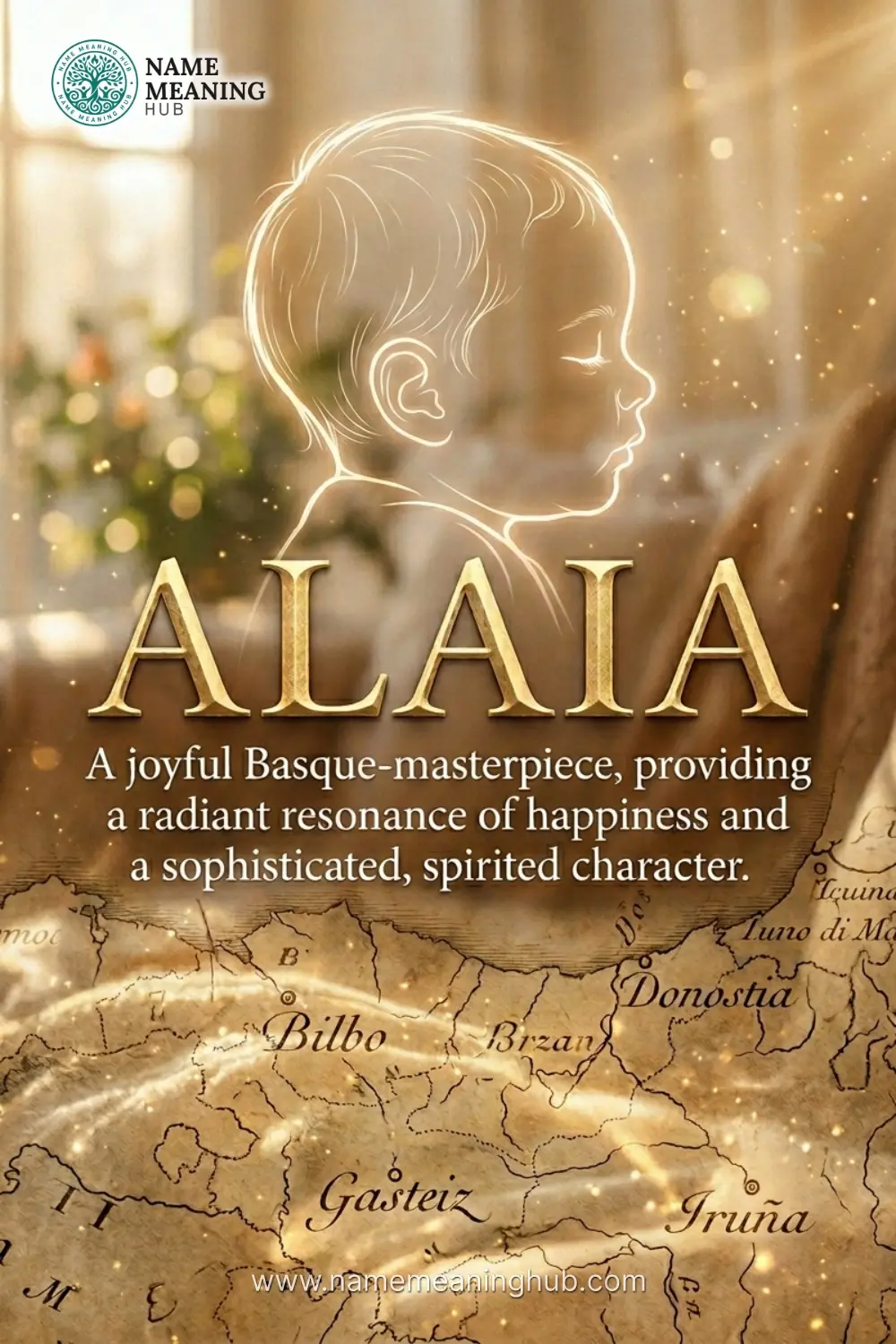
The Basque origin matters because it explains why Alaia sounds so distinct from other names that appear nearby in modern naming culture. In one of the attached naming references, Alaia is explicitly glossed as “joyful; happy,” given Basque origin, and described as a spelling that had been gaining attention as an alternative to similar-sounding names such as Aaliyah and Alaya. That context is helpful. It shows that Alaia is not simply another floating vowel name. It has a specific linguistic home, even if many modern listeners first encounter it as part of a wider family of airy, contemporary girls’ names.

Why Basque origin gives Alaia more than exotic appeal
In naming, origin can function in two very different ways. Sometimes it is used only to create a faint aura of rarity or sophistication. At other times, it provides real shape and grounding. Alaia belongs to the second category. The Basque root keeps the name from feeling synthetic. Even though it suits current tastes perfectly, it was not built yesterday to flatter those tastes. That older grounding is part of what gives the name dignity. To discover what else belongs to this origin group, browse baby names from this cultural background.
It also gives Alaia a certain clarity. Many modern names that sound similar to one another become socially interchangeable after a while. Parents may struggle to remember which spelling comes from which language, or whether a given form is newly coined or historically rooted. Alaia is helped by the fact that its Basque frame is strong and specific. The name therefore feels less like a trend fragment and more like a fully formed choice.
Alaia and its sound-neighbors
Modern ears are likely to hear Alaia alongside names such as Aaliyah, Alaya, and other open-vowel names that move easily in contemporary English. This is not a weakness. In fact, it helps explain the name’s popularity. Alaia lives in a soundscape that people already find beautiful. But the crucial point is that it still distinguishes itself inside that soundscape. Compared with Aaliyah, Alaia feels less embellished and more streamlined. Compared with Alaya, it often sounds slightly more lifted and more visibly tied to a specific origin story.
That difference matters because parents are often seeking not just beauty, but definition. Alaia offers beauty with edges. It can sit beside the era’s favorite sounds without dissolving into them.
Alaia sounds open, but its middle keeps it from floating away
Phonetically, Alaia is a very efficient name. It is built from open vowels and a single liquid-feeling glide through the center, which gives it softness. But its stress pattern is what makes the name hold together. Without the strong center, Alaia might feel too airy or too fragile. With the middle stress on LY, it gains vertical lift. The name rises and resolves instead of drifting.
Why the central stress matters so much
Pronounced uh-LY-uh, Alaia moves from a light opening into a sharper middle before relaxing again. This architecture is essential. The unstressed first syllable keeps the beginning from sounding too formal. The stressed middle gives the name its identity. The final syllable softens the landing. This is what makes Alaia sound graceful rather than vague. It has movement, not blur.
That movement is part of the name’s modern appeal. Many current favorites rely on open vowels, but not all of them have enough internal structure to remain memorable. Alaia does. You can hear the line in one pass. The middle syllable provides the hook.
The quiet strength hidden in a soft name
There is also something subtly resilient in the name’s sound. Although Alaia is undeniably soft, it is not weak. The stressed diphthong in the middle gives the name enough internal force to avoid melting into a whisper. That force is not aggressive, but it is real. It helps explain why Alaia can sound elegant on a child and still plausible on an adult. The name has enough center to age well.
That is one of the hidden challenges of modern feminine naming. Parents often want names that feel light and lyrical, but those same qualities can make a name seem insubstantial later if there is no structural backbone. Alaia avoids that problem better than many of its peers. It sounds delicate, but it has balance.
Where Alaia sits in modern American naming now
The 2024 U.S. ranking places Alaia at No. 112 for girls, which is an especially useful position for understanding the name’s cultural life. It is not so rare that people will constantly pause over it, nor so common that it loses its freshness. This is exactly where many successful contemporary names live: in the band of names that are familiar enough to feel secure, but still distinct enough to feel curated.
Why No. 112 is such a strong place for Alaia
At this level of use, Alaia benefits from social recognition without paying the price of overexposure. Teachers are increasingly likely to have seen it. Peers will not experience it as bizarre. But the child is still unlikely to feel that her name has become anonymous through repetition. This is one of the most desirable popularity zones a name can occupy. It suggests the name is established, yet not exhausted.
That position also supports the larger impression the name creates. Alaia feels current, but not trapped in a single season of naming taste. It belongs to the contemporary moment, but it does not sound disposable. A rank around this level often means the name has crossed from novelty into durable social use while still keeping some sparkle.
Alaia among its style-neighbors
Alaia belongs to a family of modern feminine names defined by breath, openness, and vowel flow. But within that neighborhood, it occupies a slightly more refined corner. Compared with trend-heavier names that rely on repeated vowels alone, Alaia feels cleaner. Compared with older romantic names, it feels lighter and less weighted by history. That combination helps it appeal to parents who want softness without syrup, movement without clutter, and a modern profile without made-up energy.
It is also significant that the name remains clearly female in current usage. That clarity gives Alaia a social ease many families value. The name can feel fresh without feeling ambiguous, which is one reason it lands so smoothly in contemporary American naming. For related naming ideas in the same category, visit more baby girl names.
What Alaia suggests in temperament and style
No name determines personality, but names do create expectations. Alaia’s expectations are unusually coherent. It tends to suggest warmth, elegance, emotional openness, and a certain low-pressure brightness. It does not sound severe, rebellious, or aristocratic. It sounds welcoming. Yet because the sound is so clean, it also avoids sounding over-familiar. Alaia feels polished without losing gentleness.
This may be the deepest reason the name works. Alaia sounds like someone easy to know, but not easy to flatten. The joy inside the name is not a gimmick. It feels like a disposition. The Basque root gives the name history. The pronunciation gives it poise. The popularity level gives it relevance. All three elements support the same social impression: a name that feels emotionally generous and aesthetically composed at the same time.
Middle names that sharpen or anchor Alaia
Because Alaia already carries softness and movement, middle names often do best when they either add a cleaner edge or reinforce the calm elegance of the first name without making the full combination too airy. If you want the full pairing logic behind that contrast, see middle names for Alaia.
Nicknames that keep Alaia intimate without losing its shape
Alaia is not a name that demands shortening, but it can support affectionate forms. The strongest nicknames usually preserve the name’s lift rather than flatten it into something generic. To see how those different moods shorten in real life, explore nicknames for Alaia.
Pronunciation that lets Alaia stay luminous
The middle stress is the key. Once the rise in the center is placed correctly, Alaia sounds as effortless as it looks. Without that, the name can lose the very elegance that makes it memorable. If you want the full sound pattern behind that rhythm, read how to pronounce Alaia.
Why Alaia still feels larger than fashion
Alaia endures because it carries more than one kind of appeal at once. It has a clear positive meaning, but it does not announce that meaning too loudly. It has a distinct cultural origin, but it lives comfortably in English-speaking life. It sounds modern, but it is not structurally flimsy. It feels gentle, but not weak. Those balances are difficult to achieve, and they are exactly what make a name last.
In the end, Alaia is a name that turns happiness into form. It does not preach joy. It embodies it in movement, openness, and restraint. That is why Alaia can feel fresh without being empty, and feminine without becoming ornamental. It gives a child a sound that feels light in the air and steady in the mind. And that is why Alaia continues to feel not merely fashionable, but fully alive as a name.