
Ainsley Name Meaning: Meaning, Character, and Quiet Strength

Some names promise grandeur, some promise holiness, and some promise charm. Ainsley does something quieter and, in its own way, more difficult. It offers possession without arrogance and place without pomp. Its meaning, “one’s own meadow,” is not about conquest or spectacle. It is about having a piece of ground that feels claimed, known, and lived in. That makes Ainsley unusual among modern names that sound airy and polished. Beneath the bright surface, it is a name about locality, belonging, and a small but deeply human kind of ownership.
That is the central thread that gives Ainsley its appeal. It sounds modern enough to move easily through contemporary life, yet its meaning is rooted in older habits of naming by land, enclosure, and residence. Historically, names like this often began as surnames or place-identifiers, attaching a person to a specific landscape. Over time, those names crossed into first-name use and gained new emotional shading. Ainsley still carries that original terrain with it. It sounds light, but it is not weightless. It sounds stylish, but it is not invented out of nothing. It is a name with grass under its feet.
Ainsley's U.S. popularity rank over time, 1950–2024
Popularity statistics are based on official data from the Social Security Administration baby name records.
Ainsley: A Spirited and Shared Nature Favorite
Ainsley behaves as a name with shared visibility without full balance, maintaining its primary strength as a feminine choice while showing a meaningful track for boys . Its appeal likely stems from its professional sound and its fit with a style family parents trust for being gender-neutral .
The chart indicates that while the girls’ lane reached a peak in 2013, its structure makes it feel open across all lanes in modern naming culture. Meaning “one’s own meadow,” its two-syllable rhythm carries a sense of fresh and confident character.
Ainsley in a Few Firm Coordinates
| Key Facts | Information | Quick Insight |
|---|---|---|
| Name | Ainsley | It looks contemporary in English-speaking life, but its structure comes from older surname and place-name habits. |
| Primary Gender Usage | Unisex | Ainsley belongs to the modern class of names that feel open rather than locked to one gendered script. |
| Primary Origin | Scottish | The Scottish frame gives the name landscape credibility and helps explain its surname-to-first-name journey. |
| Meaning | One’s own meadow | The phrase combines privacy, land, and belonging, which is why the name feels grounded despite its soft sound. |
| Pronunciation | AYNZ-lee | The bright opening and quick finish make the name easy to carry in everyday speech. |
| IPA (US) | /ˈeɪnzli/ | The internal nz sound gives the name more structure than many equally soft-looking modern names. |
| IPA (UK) | /ˈeɪnzli/ | With the same broad IPA guidance on both sides of the Atlantic, Ainsley keeps a stable spoken identity. |
| Syllable Count | 2 | Two syllables make Ainsley compact and efficient, which helps explain its broad usability. |
| U.S. girls’ rank (2024) | No. 706 | Official data shows it remains visible for girls while still feeling more distinctive than overexposed chart regulars. |
| Style Position | Modern surname-style, landscape-rooted, quietly tailored | Ainsley suits parents who want a name that feels polished without becoming ornamental. |

Why Ainsley Makes Place Feel Personal
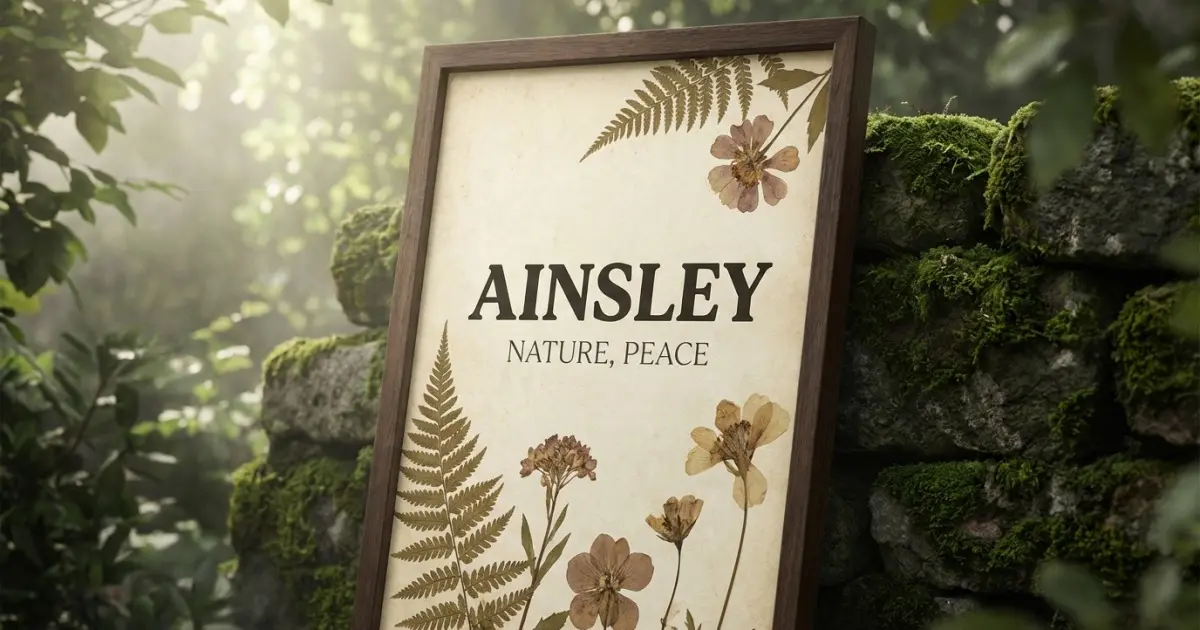
“One’s own meadow” is a more revealing meaning than it may first appear. A meadow is not a fortress or a throne. It is open land, useful land, visible land. It suggests a lived environment rather than an abstract ideal. Add the phrase “one’s own,” and the name becomes even more distinctive. Ainsley is not simply pastoral. It is personal. The meaning points to land as something inhabited, recognized, and tied to identity.
That gives Ainsley a kind of emotional realism. Many nature-linked names are built around flowers, weather, colors, or pleasing images. Ainsley is quieter than that. It does not offer ornament. It offers setting. Historically, place-based names often attached a person to a field, valley, island, or clearing. In that tradition, the name does not mean “beautiful meadow” or “wild meadow” or “distant meadow.” It means a meadow that belongs. That small difference gives the name its entire psychological charge.
The meaning feels intimate rather than decorative
This is one reason Ainsley does not read like a fantasy name even when it appears alongside more modern, styled names. The meadow in its meaning is not there to provide prettiness alone. It provides rootedness. In practical emotional terms, the name suggests a person who has a place, or perhaps who carries a sense of settled self-possession. That is a more durable feeling than mere charm.
It also explains why Ainsley often feels more substantial than some neighboring names with similar sounds. A name can be soft in the ear and still have a firm conceptual center. Ainsley does. The idea of “one’s own” introduces privacy, autonomy, and claim. The idea of “meadow” introduces openness, air, and landscape. Together, they create a name that is both gentle and held.
Why the name’s modest scale helps it
Another strength of Ainsley is scale. A meadow is not too big for ordinary life. That matters. Large meanings sometimes make names sound inflated. Ainsley’s meaning stays close enough to lived experience that it remains believable. It suggests a patch of the world rather than dominion over it. That restraint is part of the name’s modern appeal. In an age when many names aim for maximum effect, Ainsley offers a smaller, more habitable dignity.
That is why the name can sound polished without becoming chilly. It belongs to the landscape, but not in a wild, untouchable way. It belongs to the kind of environment a person might walk through, inherit, care for, or remember. The name’s emotional scale is one of its finest qualities.
From Scottish Surname to Unisex First Name
Ainsley’s modern life makes more sense once its older pattern is recognized. Name guides repeatedly record Ainsley as a surname form as well as a given name, and that is crucial to understanding how it behaves. Surname-style names often carry a different social texture from older devotional or virtue names. They feel external at first: tied to land, family line, or locality. When they cross into first-name use, they often bring with them a certain coolness and flexibility. Ainsley follows that pattern almost exactly.
It also follows another familiar route: names that emerge from surnames often become more available to both sexes over time. Research in modern baby-naming culture notes how gender-neutral options and transferred surnames have become increasingly attractive to parents looking for names that feel established but not boxed in. Ainsley fits that movement well. It appears in naming guides in both boys’ and girls’ sections, and it is also listed in Scottish female and Scottish male name groupings. That matters because it confirms the name’s unisex life is not an afterthought. It is part of the name’s actual usage history in modern reference culture. For a broader shortlist in the same group, visit more gender-neutral baby names.
The result is a name with two simultaneous identities. It is rooted enough to feel inherited and flexible enough to feel current. That combination is often what parents are searching for when they want a name that sounds smart and socially easy but does not feel overfamiliar. Ainsley has the backbone of a surname and the approachability of a first name. That is not a common mix, and it explains much of the name’s staying power.
Ainsley Sounds Lighter Than Its Rooted Meaning
One of the most interesting things about Ainsley is the tension between what it means and how it sounds. The meaning is rooted, territorial, and quietly possessive. The sound is bright, clipped, and agile. That contrast is a major part of the name’s charm. Ainsley could easily have sounded more rural or heavy if its consonants were denser. Instead, it opens with a long A sound and ends with the quick, familiar -lee finish that many English speakers process with ease.

The sound pattern makes the name feel modern
The pronunciation AYNZ-lee matters because the internal nz gives the name more definition than many soft modern names. Without that sound, Ainsley might drift into something too airy. With it, the name has shape. It begins bright, tightens in the middle, and resolves cleanly. That gives it a tailored feeling even though the ending remains gentle.
There is also a practical advantage here. Two syllables are one of the great engines of usability in naming. Ainsley is long enough to feel complete, short enough to stay efficient, and familiar enough in rhythm to be memorable on first hearing. That phonetic economy helps the name move easily through school, work, introductions, and everyday life.
Why Ainsley never sounds entirely pastoral
Even though its meaning is meadow-based, Ainsley does not sound rustic. That is significant. Some landscape names feel heavily tied to a particular rural aesthetic. Ainsley does not. The surname lineage and the sleek sound pattern pull it away from pure pastoral softness. As a result, the name can sit comfortably in very modern settings without feeling displaced.
This is one of the reasons it appeals to parents who like nature-linked meaning but do not want overtly floral or overtly whimsical naming. Ainsley gives them land without sentimentality. It gives them nature without fragility. It gives them softness with edges.
How Modern America Reads Ainsley Now
Official Social Security Administration (SSA) data places Ainsley at No. 706 for girls in 2024, and that position tells a nuanced story. The name is clearly in circulation and clearly recognizable, but it is not dominating the landscape. That makes it one of those names that many people know without feeling saturated by it. For parents, that is often ideal: familiar enough to avoid friction, distinctive enough to feel considered.
Ainsley also occupies an interesting stylistic zone in contemporary America. It shares something with other modern surname-style names that crossed into first-name use, especially names that parents value for polish, ease, and gender flexibility. Yet Ainsley is more landscape-rooted than many of those choices. It is not merely a surname transferred for fashion. It carries a visible meaning. That gives it more interpretive depth than some neighboring names built mainly on sound.
The unisex status also matters in how the name is heard now. Although current chart visibility is stronger on the girls’ side, the name’s structure does not feel narrowly feminine. That allows Ainsley to function with an openness many parents now find desirable. It can sound tailored on one child, soft on another, sporty in one setting, and literary in another. Names that can move between these impressions without strain tend to last.
Socially, Ainsley often reads as polished, self-possessed, outdoors-adjacent, and somewhat upscale without sounding inaccessible. It does not have the hardness of some surname names, nor the sweetness of some meadow-linked names. It occupies the middle ground between crisp and gentle. That is a useful place to be in modern naming.

What the Rest of Ainsley Opens Into
Middle names after Ainsley work best when they either sharpen its meadow softness or deepen its tailored calm
Because Ainsley already balances brightness and rootedness, middle names can guide the full combination toward a more formal, more lyrical, or more grounded effect. The strongest pairings understand that Ainsley does not need help sounding modern. It needs help sounding complete beside the surname. If you want the full pairing logic behind that contrast, see middle names for Ainsley.
Nicknames inside Ainsley tend to be tidy, social, and surprisingly flexible for a name that already feels short
Ainsley is compact enough to stand alone, but it still opens into plausible short forms and affectionate family use. That gives the name a second, more intimate register without making it dependent on abbreviation. To see how those different moods shorten in real life, explore Ainsley nicknames.
Pronouncing Ainsley is straightforward once the internal nz sound is heard clearly
The name’s pronunciation looks simple on paper and is usually easy in speech, but the firmness of that central sound is part of what keeps Ainsley from dissolving into something overly soft or sing-song. For the detailed stress pattern, accent notes, and IPA, see Ainsley pronunciation guide.
What Ainsley Keeps That Newer Names Often Lose
The final strength of Ainsley is proportion. It carries enough history to feel anchored, enough openness to feel current, and enough meaning to reward interpretation without becoming burdened by it. In literary terms, it is a name of contained landscape: not wilderness, not ornament, but a known place. In social terms, it offers parents something many fashionable names struggle to supply at the same time: individuality, ease, and legitimacy. If you want to expand your shortlist within this origin, browse more Scottish names.
That may be why Ainsley continues to appeal in cycles that value both polish and personality. It sounds updated, but it is not rootless. It feels unisex, but not vague. It gestures toward nature, but not in a way that turns the child into scenery. Most importantly, it keeps the human scale of its meaning intact. “One’s own meadow” is neither boast nor abstraction. It is a compact statement about having a place in the world that is recognizably yours.
That is why Ainsley lingers. Not because it is loud, and not because it is ornamental, but because it suggests a self with room around it: open land, personal claim, a clear horizon, and enough structure to make freedom feel held. Ainsley sounds modern. Its meaning remembers older ground. Between those two facts, the name finds its lasting life.