
How to Pronounce Adelyn: Syllable Guide and Easy Stress Tips

The real pronunciation test for a name like Adelyn does not happen in a glossary. It happens when a teacher pauses over a class list, when a pediatric nurse calls a child in from the waiting room, or when a grandparent sees the name written down for the first time and decides whether to trust instinct or ask for help. Adelyn does well in those moments because it looks polished without being phonetically difficult. It may resemble several neighboring names on the page, but once heard aloud, it tends to settle quickly into memory. That is one of its practical strengths: it sounds refined, but not high-maintenance.
In everyday American use, Adelyn is commonly said AD-uh-lin. The emphasis falls cleanly on the first syllable, which gives the name confidence right away. Official pronunciation guidance aligns the U.S. and U.K. forms as /ˈædəlɪn/, a useful sign that the spoken shape is stable across major English-speaking settings. That stability matters. A name can be visually beautiful and still create daily friction if people keep guessing at the sound. Adelyn avoids most of that. Its rhythm is straightforward, its vowel pattern is familiar, and its ending is soft without being vague.
What Adelyn is clarifying the moment it is spoken
| Element | Phonetic Detail | Quick Tip |
|---|---|---|
| Everyday pronunciation | AD-uh-lin | Say it in three beats, with the first one clearly strongest. |
| IPA (US) | /ˈædəlɪn/ | The opening vowel is like the “a” in “apple,” followed by a relaxed middle syllable. |
| IPA (UK) | /ˈædəlɪn/ | The U.K. form matches the U.S. form closely, so the name stays remarkably stable across accents. |
| Syllable count | 3 syllables | Think of it as Ad | uh | lin, not as two syllables rushed together. |
| Primary stress | First syllable | If the stress moves away from the opening, the name starts sounding like a different style family. |
| Middle vowel | Schwa sound /ə/ | The second syllable should stay light and relaxed, not over-pronounced. |
| Ending sound | /lɪn/ | The last syllable sounds like “lin,” not like “line.” |
| Most common issue | Confusion with nearby names such as Adaline or Madelyn | The key is the short final “lin” and the strong first syllable. |
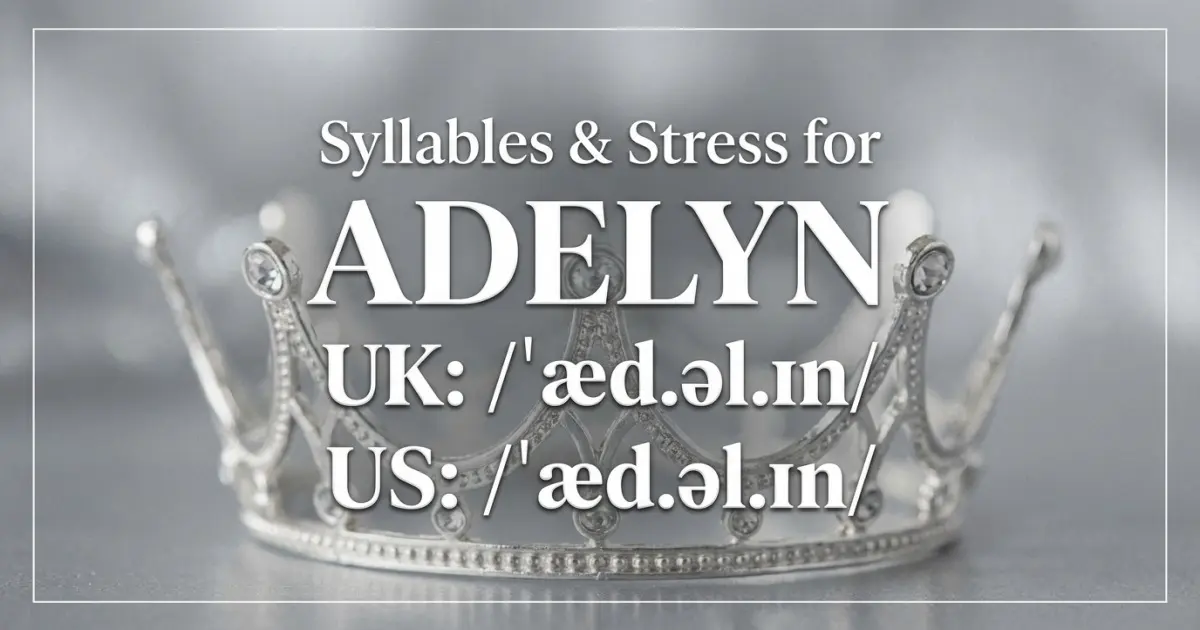
How Adelyn gets its polished sound from a very simple rhythm
Adelyn sounds graceful not because it is complicated, but because its structure is clean. The name opens with a strong stressed syllable, Ad, then moves into a reduced middle vowel, and closes with a soft but definite lin. That gives the whole name a useful shape: firm at the front, gentle in the middle, and warm at the end. It is a pattern English speakers tend to process easily. The sound matters more once you know what the name is meant to carry, which is why the wider frame starts in Adelyn meaning.
Why the stressed opening matters so much
The first syllable is where Adelyn takes hold. In linguistic terms, the vowel /æ/ at the start is the short a sound heard in words like “cat” or “add.” Because that syllable is stressed, it becomes the anchor of the whole name. You do not drift into Adelyn. You arrive in it immediately. That is one reason the name feels more grounded than many other soft modern girls’ names. The opening gives it a clear center of gravity. Once the sound pattern is clear, some shortenings stop feeling optional and start feeling natural, and the clearest map is in nicknames for Adelyn.
This also helps the name sound capable in adulthood. Names with first-syllable stress often feel direct and stable in English, and Adelyn benefits from that effect. The pronunciation does not hover or trail off. It starts decisively, then softens.
Why the middle of Adelyn should stay relaxed
The second syllable is a schwa, the most common unstressed vowel sound in English. It is the quick, neutral uh that appears in countless everyday words and names. This matters because some speakers are tempted to over-enunciate the middle of an unfamiliar name, especially when they want to be careful. With Adelyn, too much effort in the middle usually makes the name sound less natural, not more. The second syllable should pass lightly.
That relaxed middle is part of what makes Adelyn feel conversational. Even though the name looks elegant in print, the spoken form is not stiff. The schwa keeps the rhythm moving.
Why the ending “lin” is softer than it looks
The final syllable is lin, not line. That distinction is important. Names that end with a short lin feel softer and more compact than names ending with the long-I sound. The l in this syllable is a liquid consonant, which helps the ending flow instead of snap. There are also no fricatives in the name—no f, v, s, or sh sounds rubbing against the ear—so the overall effect stays smooth.
That soft ending is one reason Adelyn sounds approachable. The name begins with clarity, but it does not finish harshly. It closes with warmth.
Where Adelyn gets misheard, and why the mistakes are so predictable
Adelyn is not a difficult name, but it does sit near several very familiar sound neighbors. Most pronunciation problems happen because speakers see the spelling and unconsciously substitute a pattern from another name they already know. In practice, the errors are usually predictable and easy to correct.
When Adelyn gets pulled toward Adaline or Adalyn
The first major confusion comes from names with similar beginnings but different final vowels. Some readers see Adelyn and instinctively move toward a pronunciation closer to AD-uh-line. That produces a completely different ending pattern. The correct form keeps the last syllable short: lin. A useful mental shortcut is to think of the end of “linen” without the final n, rather than the word “line.”
This is the most important correction point because once the ending shifts, the name enters a different style family altogether. Adelyn depends on that short closing syllable to sound like itself.
When Adelyn gets blended with Madelyn or Addison-style rhythms
The second common issue is association with neighboring contemporary names. Because Adelyn shares some sound territory with Madelyn, Addison, and similar names, speakers sometimes flatten the rhythm or add a slightly different melodic contour. This usually does not produce a catastrophic mispronunciation, but it can blur the name’s identity. Adelyn is a three-beat name with a strong first syllable and a compact end. If the rhythm starts sounding too stretched or too sing-song, it loses precision.
A practical listening test helps here: the strongest sound should be Ad, and the last sound should be a quick lin. If either of those changes, the name is drifting.
Adelyn across accents stays stable because the hard part is already solved
One of Adelyn’s quiet advantages is that accent differences tend to be mild rather than transformative. The official U.S. and U.K. IPA forms are the same: /ˈædəlɪn/. In real life, some speakers may color the short a slightly differently, and the exact quality of the final vowel may vary a little depending on region. But those differences usually amount to accent shading, not structural change.
What may vary across speakers
The opening vowel may sound a little brighter or flatter depending on region. The middle schwa may be clipped very quickly in faster speech. The final lin may come out a touch softer or tighter. None of these changes normally interfere with recognition because the name’s basic architecture remains intact: first-syllable stress, light middle, short ending.
That makes Adelyn highly portable. It does not rely on a narrow local pronunciation or a fragile vowel sequence to sound right. Parents who want a name that will travel well across classrooms, workplaces, and accents often find that quality especially appealing.
Practicing Adelyn is easier than memorizing it
The easiest way to teach Adelyn is to feel its pulse instead of dissecting the spelling. Say it as three beats: AD | uh | lin. The first beat should be strongest, the second should be quick and relaxed, and the third should close softly. Once you hear that pattern, the name becomes intuitive.
Practice lines that make Adelyn sound natural
Try the name inside real sentences rather than as an isolated drill. “Adelyn is here.” “Can Adelyn come in?” “I saved this for Adelyn.” In connected speech, the rhythm becomes easier to hear because the name settles into ordinary English pacing. That is often how people truly learn a name: not by reading a phonetic guide once, but by hearing it used naturally several times.
How to remember Adelyn when you see it written down
If you are meeting the name first on paper, focus on two things. First, the beginning is Ad, like the start of “add.” Second, the ending is lin, not “line.” Those two anchors usually solve the whole pronunciation. The middle will take care of itself because it is a simple schwa.
That is what makes Adelyn so workable in daily life. It looks polished, but it does not hide a difficult sound system. It has enough softness to feel graceful, enough stress clarity to feel solid, and enough phonetic simplicity to remain easy after one hearing. A name that can do all three has already solved one of the hardest naming problems: it keeps its elegance once real people start saying it out loud.
How to Pronounce Adelyn: FAQ
How do you pronounce Adelyn correctly?
Adelyn is commonly pronounced AD-uh-lin, with the strongest stress on the first syllable and a short final lin sound.
What is the IPA pronunciation of Adelyn?
The standard IPA form is /ˈædəlɪn/ in both U.S. and U.K. usage. That reflects a stressed opening syllable, a relaxed middle schwa, and a soft final syllable.
What is the most common pronunciation mistake with Adelyn?
The most common mistake is saying the ending like “line” instead of “lin.” This usually happens because people confuse Adelyn with nearby names such as Adaline.
Is Adelyn hard for English speakers to pronounce?
No. Although the spelling can resemble other names, the spoken form is straightforward once heard. Most English speakers can say it comfortably after one correction, and many will get it right immediately.