
Adam Name Meaning: Origin, Character, and Quiet Strength

Adam is one of the few names in common use that still sounds like the beginning of a story. Its central meaning, “man; red earth,” places it at the point where language, body, and ground meet. That is what makes the name so durable. Adam does not begin in glamour, conquest, or aristocratic polish. It begins in the oldest imaginable human material: earth. In the biblical imagination, Adam is not introduced as a prince or a hero but as the first man, the figure formed from the ground itself. Even stripped of theology, that image has enormous force. Adam is a name of origin, of firstness, of human life understood as made rather than manufactured.
That is why Adam has survived so many different naming eras. It is simple enough to pass for plain, yet the idea underneath it is vast. In everyday English, Adam can sound almost transparent because it has been familiar for so long. But the name has never really been empty. Behind it stands one of the oldest human questions in naming: what does it mean to name a child after humanity itself? Adam answers that question not with ornament but with matter. It ties the human person back to earth, to making, to embodiment, and to the oldest stories of origin that many families still recognize instinctively.
Adam's U.S. popularity rank over time, 1880–2024
Popularity statistics are based on official data from the Social Security Administration baby name records.
Adam: A Foundational Biblical Anchor
Adam functions as a name with one unmistakable center of gravity, sustained by a deep biblical tradition that has anchored it as a primary choice for boys for generations. Its enduring profile often reflects a preference for “heritage classics” that feel strong and structurally reliable .
The trace presence in the girls’ lane behaves more like a scattered edge than a true second track. Meaning “man,” its simple two-syllable rhythm provides a sense of permanence that transcends shifting naming cycles.
What Adam tells you before the deeper reading begins
| Key Facts | Information | Quick Insight |
|---|---|---|
| Name | Adam | The form is brief and familiar, but its conceptual reach is much larger than its size suggests. |
| Primary gender usage | Male | Adam remains one of the clearest and most stable masculine classics in English-speaking use. |
| Origin | Hebrew | The name belongs to one of the deepest biblical naming traditions, where language and creation are closely linked. |
| Meaning | Man; red earth | This is a rare meaning that joins human identity directly to the material world rather than to rank, beauty, or victory. |
| Pronunciation | AD-uhm | The easy spoken form is one reason Adam carries such large history without sounding heavy. |
| Syllables | 2 | Two syllables give Adam enough structure to feel complete while keeping it highly usable in daily life. |
| U.S. boys’ rank (2024) | No. 100 | The name remains visible and trusted, but no longer feels automatic in the way it once may have. |
| Historical profile | A foundational biblical classic | Adam does not merely come from scripture; it helps define what a biblical first-man name looks like. |
Adam begins in the ground, which is why the name never feels ornamental
Most names derive their charm from social meaning. They suggest nobility, courage, sweetness, brightness, or blessing. Adam does something different. It goes lower. It roots itself in the earth. Naming books and biblical references repeatedly connect Adam to earth, red earth, and the Hebrew word adama, the ground from which the first man is formed. That link matters because it gives the name a physical basis. Adam is not only a human being in the abstract. He is a creature of the soil. For parents interested in this heritage, a good next step is browse Hebrew baby names.
This earth-connection is one reason the name never feels decorative, even when it sounds familiar enough to fade into the background. Its logic is elemental. Adam suggests the human person as made from matter, tied to land, mortality, and embodiment. Even for families who are not explicitly choosing it for theological reasons, that symbolism still shapes the atmosphere of the name. Adam is not airy. It is grounded. It does not sound like something spun from imagination alone. It sounds like something made with hands.
The “red earth” layer deepens that effect. Redness adds physicality and color to what might otherwise be a purely abstract religious gloss. The name therefore does two things at once. It identifies a man, and it reminds the listener that man comes from earth. Very few names carry that kind of anthropological depth while remaining so simple in daily use. Adam manages it because its core meaning is not sentimental. It is primal.
Adam is the first man, but the name’s real power is not grandeur
It would be easy to assume that a name attached to the first man in the Bible must feel overwhelmingly symbolic. In practice, Adam does not sound grandiose at all. That is one of its strangest strengths. According to biblical tradition and the naming books that summarize it, Adam is the first man on Earth. That could have made the name impossibly mythic. Instead, it made the name foundational. Adam belongs less to pageantry than to beginnings.

This distinction matters. Some origin names become too large to wear. Adam does not. Its biblical status gives it gravity, but its sound keeps it close to ordinary life. This is one reason Adam has remained far more usable than many other ancient scriptural names. It has a universal place in the story, yet it does not demand a dramatic personality from the child who bears it. A boy called Adam does not seem burdened by prophecy or spectacle. The name feels calm, broad, and human-sized.
There is also something culturally powerful in the phrase “son of Adam,” which many traditions use to mean simply “person” or “human being.” That extension helps explain why Adam often feels less like a name of exceptionalism and more like a name of human universality. It names one man, but it also gestures toward all men. In that sense, Adam is both individual and collective. It is personal, but it still carries the outline of humanity itself.
Adam sounds plain because the phonetics are doing quiet, useful work
Part of Adam’s endurance comes from its sound. AD-uhm is neither especially ornate nor especially clipped. It begins with a broad, open vowel, lands firmly on the stressed first syllable, and then softens into an unstressed ending. That pattern is highly natural in English. The name is easy to catch across a room, easy to write, easy to repeat, and easy to age with. A child can wear it, a professional can wear it, and an older man can wear it without the sound ever seeming out of scale.
Phonetically, Adam sits in a strong position. The short opening is stable and masculine without being hard. The second syllable relaxes the line, which keeps the name from sounding too severe. There are no ornate consonant clusters and no tricky vowel combinations. That ease matters. A name with such a large symbolic burden might have felt too solemn if its sound were more elaborate. Adam survives precisely because the sound is so livable.
This is also why Adam has remained so internationally portable. Naming references list related forms across languages—Adán, Adamo, Àdhamh, and others—and the core remains recognizable. The English Adam may be the simplest of these, but it benefits from belonging to a wider family. That translatability gives it extra resilience. It can move between scriptural tradition, family use, and modern secular life without losing its center.
Adam remains one of the rare biblical names that still feels ordinary in the best way
Official Social Security Administration (SSA) data places Adam at No. 100 for boys in the United States in 2024. That ranking tells an interesting story. Adam is no longer the kind of name that dominates the uppermost ranks as if it were unavoidable, but it remains firmly inside the zone of active familiarity. People know it. They can say it. They have met Adams before. Yet the name does not currently feel overexposed. That is often an ideal position for a classic.
Adam’s long social success comes from the fact that it solves several naming problems at once. It is biblical without sounding overly liturgical. It is traditional without feeling antique. It is masculine without theatrical toughness. It is familiar without being shapeless. This combination has made it one of the great baseline boys’ names in English. Baseline does not mean boring here. It means structurally sound. Adam is the sort of name families return to when they want something rooted, legible, and unlikely to age badly. To see what else belongs in this group, browse browse boy names.
There is another reason Adam wears time well: it does not belong to only one kind of household. It works in religious families, secular families, literary families, minimalist families, and multicultural families. Some names can survive only by leaning into a specific aesthetic. Adam does not need an aesthetic to survive. It survives on simplicity and depth alone. That is rare.
Adam carries a surprising amount of cultural range for such a compact name
Because Adam sounds so familiar in English, it is easy to forget how widely the name travels. Naming books preserve forms of Adam in Hebrew, English, French, Spanish, Italian, Gaelic, Finnish, and beyond. This matters because it shows Adam is not just a biblical English staple. It is a cross-cultural human name, one of those rare forms that can move through languages while staying recognizable.
That range affects how the name feels today. Adam can sound plain in one context and cosmopolitan in another, depending on the family’s linguistic and religious background. For some, it is the first man’s name. For others, it is a timeless Jewish or Christian inheritance. For others, it is simply one of the clearest male names available. This layering adds richness without making the name unstable. Adam still feels like Adam almost everywhere it goes.
It also helps explain why Adam rarely sounds dated in the way some era-heavy names do. The name has too many entry points to be trapped by one generation’s style. It belongs to scripture, yes, but also to everyday speech, to surname derivatives like Addison, and to a wider international family of related forms. That breadth keeps it fresh even when it is very old.
Adam and the idea of humanity make the name more than a label
What makes Adam truly enduring is that it names more than an individual. It names a condition. In religious language, Adam is the first man; in broader cultural language, Adam often becomes a figure for humanity itself. That makes the name conceptually larger than many of its biblical peers. It does not simply point to one story episode. It points to the human beginning.
This has an interesting emotional result. Adam can feel universal without feeling vague. It suggests the ordinary dignity of being human. It ties a child not to royalty or rarity, but to the oldest human image of life formed from earth. In a naming culture often obsessed with distinction, Adam offers a different kind of strength. It says that there is depth in the basic, meaning in the elemental, and nobility in the idea of being fully human rather than theatrically exceptional.
That may be one reason Adam still sounds so honest. It does not pretend to be more than it is. It lets the story behind it do the lifting. And the story is one of matter, breath, firstness, and human life itself. Few names carry that much without straining.
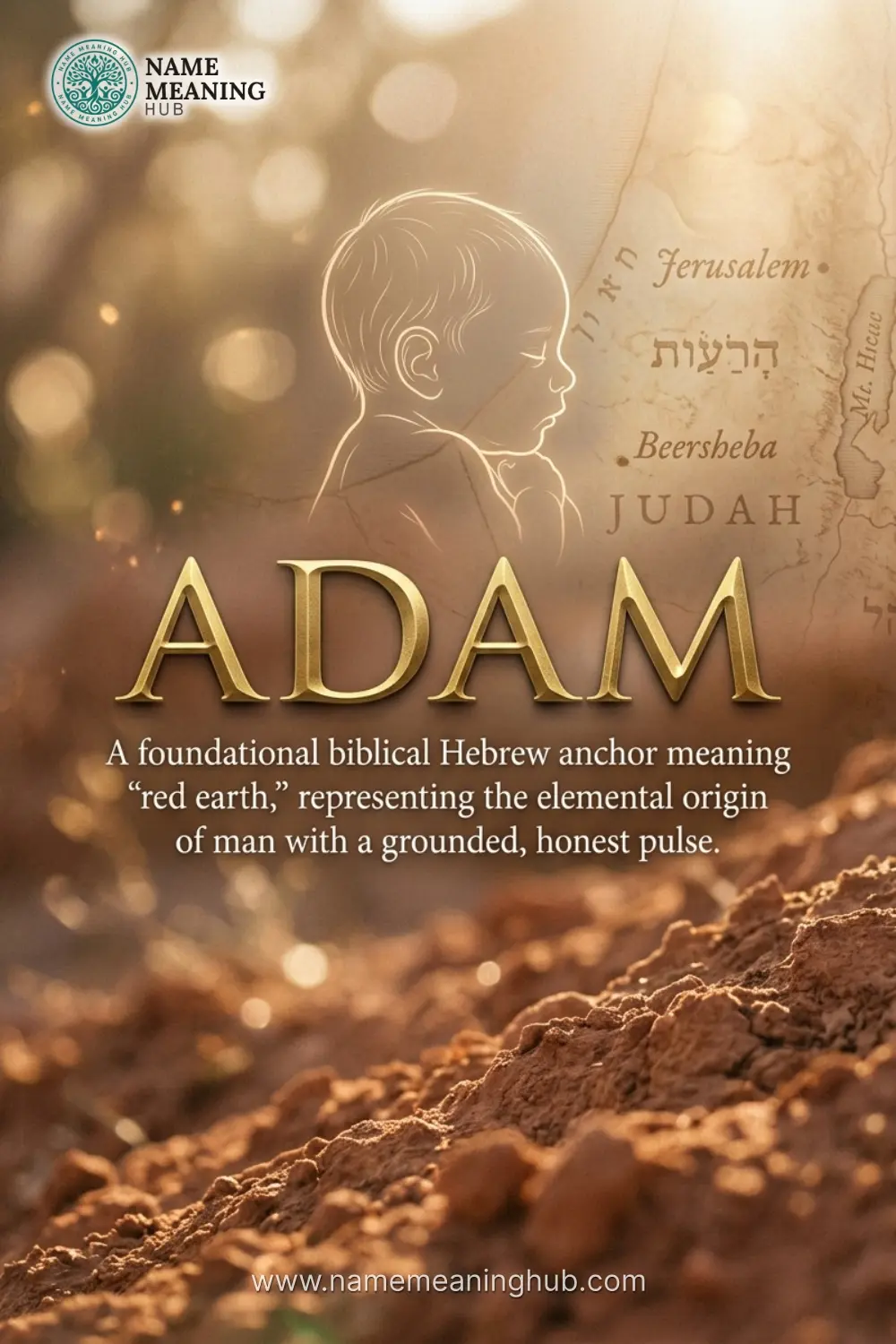
Where Adam opens next once the meaning is clear
Adam with middle names can sound either sharper or more ancestral
Because Adam is so balanced and familiar, the middle slot becomes especially important. It can make the full name feel lean and modern, or deepen it with family and biblical weight. If you want the full pairing logic behind that contrast, see middle names for Adam.
Adam and nicknames are quieter than many parents expect
Adam has a shorter, calmer nickname life than some classics. That matters if you want a name that is usually used in full and does not depend on a diminutive to feel warm. To see how those different moods shorten in real life, explore Adam nicknames.
Adam and pronunciation are part of the name’s long success
AD-uhm is one of the easiest classic male names to say in English. That phonetic ease helps the name carry its ancient story without sounding heavy or difficult. If you want the full sound pattern behind that rhythm, read Adam pronunciation guide.
Why Adam still feels like a beginning we have not outgrown
Adam endures because it joins two things modern naming often pulls apart: scale and simplicity. It is a name of the first man, of earth, of red earth, of making, of humanity itself—and yet in everyday speech it remains one of the least pretentious names a family can choose. It does not perform its symbolism loudly. It lets the symbolism remain in reserve, available for anyone who wants to go looking.
That is the final beauty of Adam. It sounds ordinary because the human story it carries is ordinary in the deepest sense: universal, bodily, mortal, grounded. The name does not promise brilliance, victory, or rank. It promises something older and more durable than that. It places a life back into the soil from which life is imagined to rise. Adam, at its best, is not only a biblical classic. It is a name that remembers what a human being is made of—and speaks that truth in a voice so plain it can still be heard.